






Introduction
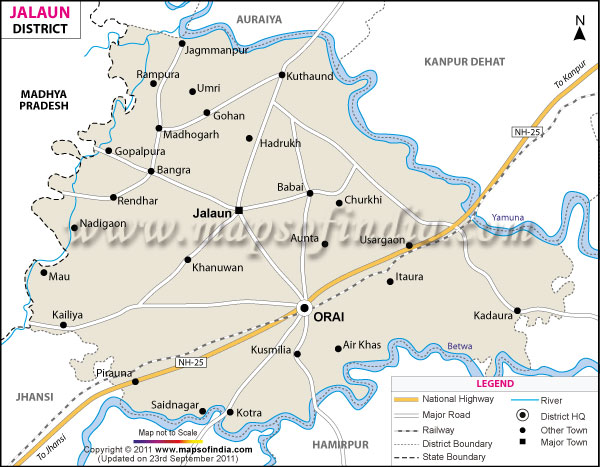
The Jalaun district is in the southwestern region of the Indian state of Uttar Pradesh and it is a substantial region of Bundelkhand region. The seat of the district is the town of Orai, where is the chief seat of government, business and communication. The territory can be described as a combination of countryside, ancient settlements and farming. The Jalaun district map can be used to identify where agricultural lands and sources of irrigation are located that support the lives of the locals.
A number of historical and cultural centres of Bundelkhand are also linked to the district. The towns and villages of it have traditions dating centuries. The Jalaun district map assists the traveller and the researcher find these settlements and appreciate how these are spread throughout the district. The district has been slow in developing infrastructure that has connected the rural areas to the urban centres. Orai and other towns are linked by road and rail networks to the major cities in Uttar Pradesh and other neighbouring states.
History
Jalaun district is directly related to the overall development of the history of the Bundelkhand region. The area was a component of some of the earliest Indian kingdoms that existed in ancient times that governed the north and central India. Archaeological data and historical information indicate the Mauryan Empire influenced the land in the third century BCE by the rule of Emperor Ashoka. Historians regularly use the Jalaun district map and show where the ancient settlements and the historical trails existed in the past.
In the early medieval times, the area was under the influence of different Rajput dynasties which ruled different regions of Bundelkhand. The political and cultural life of the district was determined by the forts, temples and administrative centres which were created during this period. The Jalaun district map assists the scholars to trace the sites of historical towns that emerged under these dynasties.
The Bundela rulers later significantly contributed towards the history of the region. The Bundelas had taken strongholds all over Bundelkhand and helped in building local architecture, temples and administration centers. They had an influence over much of modern day Jalaun district.
In the eighteenth century, Maratha Empire gained control over Bundelkhand which transformed the political landscape in northern India. Jalaun and areas around it were under the Maratha rule. Many of the Jalaun district maps indicate the sites of towns which were the administrative centres of this time.
The region finally fell under the rule of the British in the nineteenth century following the growth of the British East India Company in northern India. British rule brought with them novel forms of government, taxation as well as building infrastructures. The district started to be connected with other countries by railways and roads.
An Indian freedom movement was also felt in the district. In line with most parts of Uttar Pradesh, the area of Jalaun also witnessed the political involvement of the local leaders and citizens, who were interested in the independence movement. The district became a part of the state of Uttar Pradesh after India became an independent state in 1947 and still remains in its development as a district.
The historical heritage of Jalaun district is still evident in the form of the towns, temples and traditional settlements today. Scholars of the local history tend to use the Jalaun district map to locate the positions of historical sites and see how the district was evolving in various historical eras.
Culture
Jalaun district represents the cultural life of the Bundelkhand region which is based on its traditions and social practices. The community in the district is very close to their history and this is manifested in terms of festivals, folk songs, local traditions and local celebrations. These traditions are still significant in influencing the social life of the rural and city life.
The district is celebrated with great experts when it comes to religious festivals. Dussehra, Navratri, Diwali, and Holi are the major Hindu festivals which families and communities observe with classic rituals and meetings. These events make markets and towns in the district centres of cultural activity. Tourists who visit the area tend to consult the Jalaun district map when seeking where significant events go on in the towns. Cultural performance of folk music and dance is also vital to the district. Bundeli folk songs are comprised of tales of heroism, love and the normal life of rural people.
Another peculiarity of the cultural landscape is local fairs, also called melas. The fairs unite the villagers of various regions within the district in trade, entertainment and religious activities. An elaborate map of the Jalaun district assists the traveller to know the places of significance of the towns where these fairs are held.
Crafts and traditional jobs are also a part of the cultural identity of the district. Artisans make pottery, woven products and other hand made products that represent local crafts. These are activities that have been in the rural life over the generations and still give livelihood to most of the families.
Towards the Bundelkhand and the northern part of India, the cuisine of Jalaun district is typical. Breads made of wheat like roti are also part of the staple foods where lentils, vegetables and produce of the season also feature. During the festivals and other special events, the traditional sweets and snacks are made, which enrich local food culture. All in all, the culture of Jalaun district is a combination of agricultural life, local heritage and long-term traditions which have remained alive due to the generations of the community life.
Language
Jalaun district as a region is linguistically diverse. The official language spoken in management, schools and government communication is Hindi in the whole district. It is a common knowledge and applicable in the formal circles like schools, offices and government facilities. Besides Hindi, another language spoken in the local communication of the residents of the area is Bundeli.
The language of the district shows the process of co-existence between standard Hindi and local dialects. Although Hindi is the language of instruction in most institutions of learning, Bundeli is still used as a cultural language that translates local culture and language. Educational and administrative centres where Hindi is more pronounced are sometimes marked in the Jalaun district map.
Language has been used in the maintenance of oral traditions as well. Folk songs, proverbs and story telling traditions are usually translated in Bundeli, which has made it possible to transfer the cultural values and historical memories between one generation and another. A large number of these cultural manifestations take their origin in rural areas which can be traced in the district by a detailed Jalaun district map.
Along with Hindi and Bundeli, there might also be the presence of other languages, like Urdu, or other languages under the influence of other cultures and migration. Nevertheless, the general linguistic character of the district is fixed strongly to the traditions of Hindi and Bundeli. With the growth of education and media newer generations are also learning standard Hindi and in some cases English too.
Geography
The Jalaun district lies in the southwest of the Uttar Pradesh and it belongs to the Bundelkhand plateau. The district is being situated between two river systems Yamuna and Betwa which shape the natural landscapes of the area and agricultural structure. It is plains mainly with some rocky land characterising Bundelkhand. This area is about 4,565 square kilometres. Jalaun district map gives an explicit map of the administrative units of the district, tehsils, towns, and villages that are scattered within the area.
The geographical and economic environment of the district is dominated with agriculture. Crops grown on the fertile plains are wheat, pulses, mustard and gram. In certain areas of the district irrigation is also supported by canals, wells and occasional rains. Agricultural lands and irrigation systems are frequently identified as part of the Jalaun district map, which facilitates the agricultural activities.
Jalaun district is characterised by the climate which is dominated by hot summer, monsoon seasons that are characterised by relative rainfall and relatively cool winter. Agriculture is, more importantly, requiring the use of the monsoon months due to the fact that in many regions, crop productivity is dependent on the rainfall.
Streams of rivers and seasonal streams are significant in determining the geography of the district. The close location of Yamuna River affects the earth structure and access of water to various regions of the district. In case of studying the map of the Jalaun district, it is possible to see the distribution of settlements and agricultural fields in relation to these sources of water.
The development pattern of the district is quite ruralistic, with many villages scattered over the land. Towns like Orai serve as administrative and commercial hubs which facilitate the rural communities to the rest of the markets and services. In general, the geography of the Jalaun district represents the specifics of the Bundelkhand region as a whole, the combination of agriculture, rural settlements and river systems leads to the formation of a unique landscape, which is created by both natural and human affairs.
| Facts of Jalaun District | |
|---|---|
| State | Uttar Pradesh |
| District | Jalaun |
| District HQ | Orai |
| Population (2011) | 1689974 |
| Growth | 16.19% |
| Sex Ratio | 865 |
| Literacy | 73.75 |
| Area (km2) | 4565 |
| Density (/km2) | 366 |
| Tehsils | Jalaun, Kalpi, Konch, Madhogarh, Orai |
| Lok Sabha Constituencies | Jalaun |
| Assembly Constituencies | Kalpi, Madhaugarh, Orai |
| Languages | Hindi, Urdu, Bundeli |
| Religion | Predominantly Hinduism |
| Rivers | Yamuna, Betwa, Pahuj |
| Lat-Long | 26.130782,79.468803 |
| Travel Destinations | Fort Jagmanpur, Radha Krishna Mandir, Kamaksha Devi Mandir, Maa Kali & Shiv Mandir, Choti Mata Mandir, Dwarikadeesh Mandir, Bambai Wala Mandir, Nana Maharaj Mandir, Ganesh Ji Mandir, Hanuman Mandir, Shiv Ji Mandir etc. |
| Government Colleges/Universities | M.K.J.A Government Medical College, Gandhi Degree College, Maharani Bai Inter College, Chhatrasal Inter College, Dr. Ambedkar Inter College, Mathura Devi Girls Inter College, M.L.B. Inter College, Govt. Inter Collage etc. |
FAQs
Q1: Where is Jalaun district located?
Jalaun district is located in the Bundelkhand region of southwestern Uttar Pradesh.
Q2: What is the administrative headquarters of Jalaun district?
The district headquarters is the town of Orai.
Q3: What is the main economic activity in Jalaun district?
Agriculture is the primary economic activity for most residents.
Q4: Which rivers influence the geography of Jalaun district?
The Yamuna and Betwa river systems influence the district’s geography and agriculture.
Last Updated on : May 08, 2026
