

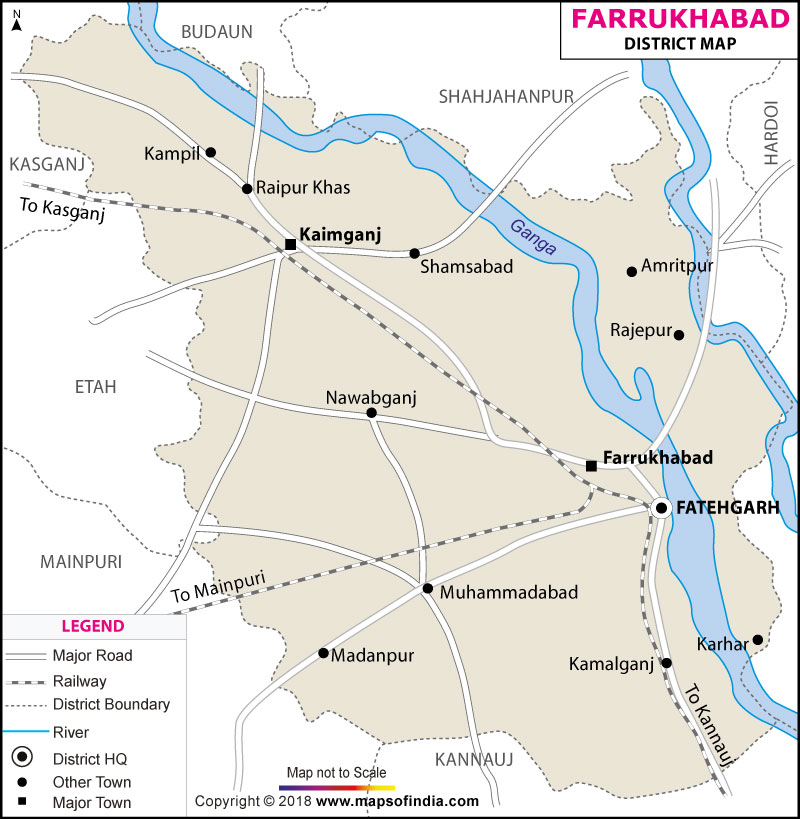





Introduction
Farrukhabad has been developing over centuries passing through different political regimes, social changes and economic advancements and tried to maintain its unique identity. It has always served as a linking point between the cities such as Kanpur and Bareilly since it lies between the two major cities in the region. The fertile plains near Farrukhabad also serve as a contributing factor to the agricultural prosperity with such crops as wheat, rice and potatoes being widely grown in the area. The Ganga does not just enriches the soil, but it also has a religious and cultural meaning to the individual in Farrukhabad.
History
It was established in 1714 by Nawab Muhammad Khan Bangash, a potent Afghan chief and a military leader who attained great status under the Mughal Empire. He named the place after the emperor of the time, Farrukhsiyar, which signified both his allegiance to the Mughal court and his own increasing dominance in the region. Farrukhabad became a major seat of governance and military power under the rule of Bangash. The Nawab created forts, administrative offices and residential quarters, and this made the region a planned urban city. It was also given more significance because of its strategic positioning in fertile Gangetic plains making it an easy location for trade, practice agriculture and to communicate.
With the start of the decline of the Mughal Empire in the middle of the eighteenth century, Farrukhabad, like most other regional centers, got involved in power wars typical of this period of transition. The weakening of the central authority paved the way to the domination of other forces like the Maratha Confederacy, local Nawabs, as well as the rising European trading firms. During this period, there was shifting allegiance, military conflicts and political unrest in Farrukhabad. Such events changed not only the political environment, but also the region’s economic life because trade routes and administrative mechanisms were often destroyed and obstructed.
The power of the British East India Company rapidly spread in North India in the second half of the eighteenth century. Farrukhabad later became a part of British rule, and the new era of its history began. The town became a part of the British bureaucracy during colonial rule. The British brought in new revenue collection systems, law systems as well as governance which transformed the old institutions. The development of the infrastructure turned into one of the main features of this time, and the roads, railroads, and governmental buildings were built to make the administrative work more efficient and assist in extracting the resources.
In spite of this, there were also serious challenges associated with colonial rule. New land revenue systems tend to impose heavy burdens on the farmers.Local craft and industries were unable to compete with the imported British goods. This resulted in the economic dislocation and social changes that influenced the life of the inhabitants on a daily basis. Nevertheless, Farrukhabad continued to be a significant administrative as well as a commercial hub in the region despite these difficulties.
The town was also involved in a nationalistic fight against British rule. In revolts like the Indian Rebellion of 1857, as well as subsequent stages of the freedom movement, the local people played a role in the movements through protests, resistance and political mobilization. Nationalism gradually grew in the region with the help of the leaders and movements around the country. The involvement of Farrukhabad in these struggles indicates that it was a part of the bigger picture of fighting against British rulers of India to gain independence.
After the independence in 1947, Farrukhabad was incorporated into Uttar Pradesh in the independent India. The period of post-independence was a shift that saw the development towards democratic governance of the country and planned development. There was pressure to increase education, healthcare infrastructure, and develop infrastructure. Throughout the years the district adjusted to the transition of the modern economic and political environment without abandoning the aspects of the past.
Culture
The culture of Farrukhabad is a result of such a heterogeneous population and historical background. It also has a tradition of textile block printing that is one of the most prominent features of its culture. Farrukhabad artisans have nurtured this art for long generations and have generated some elaborate designs that are valued both within and outside the country.
Their festivals like Diwali, Holi, Eid and Navratri are celebrated with much excitement. Such festivals also unite people and lead to the feeling of unity and identity. Due to the presence of the various religious communities it is a place where diversity is embraced.
In Farrukhabad, the other aspects of culture that are significant are music and dance. It has folk songs which are usually transmitted through generations and are sung at weddings and festivals. Such songs include the feelings, culture, and daily experiences of the people. Traditional dancing makes celebrations colorful and a way to express one's culture.
Another example of cultural diversity is the cuisine of Farrukhabad. It incorporates North Indian dishes that are diverse in flavors due to its varied spices.. There is common consumption of wheat-based breads, rice, and lentils, among other staple food items. The culture of street food is also significant as it provides an assortment of sweets and snacks, which are both popular among the residents and tourists.
Language
Farrukhabad is culturally diverse, as it is reflected in its language. The major language used in the region is Hindi, the official language in education, administration and in everyday communication. It is a medium that brings people of other communities together in Farrukhabad.
Urdu is also a very important language of Farrukhabad. It is closely associated with the Mughal and Nawabi history of the area. Urdu has also been linked to poetry, literature and the cultural expression which enhanced the linguistic heritage of Farrukhabad.
There are regional dialects that are spoken in rural areas, e.g. Kannauji. These dialects embody the local traditions and form an important part of everyday communication. They preserve oral history, folklore and communal identity serving as important cultural resources.
Farrukhabad contains several languages which point to its inclusiveness. People code-switch between languages by context, creating linguistic flexibility. Such diversity brings richness to social activities as well as adding to the culture of the area.
Education has been a factor in the promotion of language in Farrukhabad. Educational systems and establishments promote standard Hindi and at the same time appreciate regional dialects. Consequently, the language milieu of Farrukhabad still keeps on changing and retaining its ancient foundations.
Geography
The Farrukhabad geography is defined by the location of the territory in one of the fertile and most important regions of the historic northern India. The district lies in the Ganga-Yamuna Doaba, a region with a topography that has favoured a densely populated and premium agricultural production since time immemorial. The interfluvial division is situated between two large river systems and has always been perceived as one of the central lands of agrarian economy and cultural development.
An important geographical characteristic of Farrukhabad is the fact that it lies adjacent to the Ganga River, which is the main determinant of the physical environment and the local economy. The river also helps in the gradual deposition of fertile sediments thus forming fertile alluvial soils. The soil of this kind is especially conducive to the intensive type of agriculture practice, which permits cultivation of a wide variety of crops throughout the year. The agriculture scene is dominated by staple foods like wheat and rice and cash crops like potatoes and pulse which contributes to the region’s economic stability.. The river and also canals, tube wells and seasonal rainfalls substantially support irrigation, thus making the production of agricultural produce quite predictable.
Farrukhabad lies in a subtropical climate which is characteristic of northern India. It has three different seasons, which play a huge role in determining the agricultural cycles as well as life in the area. Characteristic of summers are high temperatures with the intense dry winds (loo) which might impose strain on crops and water resources. This is succeeded by the monsoon season whereby most of the rainfall of the year is received in the district. Monsoon plays a significant role in rejuvenating the ground water reserves as well as supporting crop production hence, a very important part of the local agrarian economy. Winters, however, are quite cool and nice and they offer a good environment for the production of rabi crops like wheat and some vegetables.
The area of Farrukhabad is majorly flat which is the common characteristic of the Indo-Gangetic plains. This level ground provides extensive farming and easy creation of transportation networks. The location of rural settlements is very decentralized throughout the district since it is agrarian, people rely on villages as primary economic centers. Concurrently, city hubs that are located in the district are slowly growing, and this growth has been aided by infrastructure development such as road networks and rail networks. These improvements have contributed to better trade and movements, which have brought Farrukhabad closer to other towns and the larger economies.
| Facts of Farrukhabad District | |
|---|---|
| State | Uttar Pradesh |
| District | Farrukhabad |
| District HQ | Fatehgarh |
| Population (2011) | 1885204 |
| Growth | 20.05% |
| Sex Ratio | 874 |
| Literacy | 69.04 |
| Area (km2) | 2279 |
| Density (/km2) | 865 |
| Tehsils | Amritpur, Farrukhabad, Kaimganj |
| Lok Sabha Constituencies | Farrukhabad |
| Assembly Constituencies | Amritpur, Bhojpur, Farrukhabad, Kaimganj |
| Languages | Hindi, Urdu |
| Rivers | Ganga, Ramganga |
| Lat-Long | 27.44004,79.468803 |
| Travel Destinations | Fatehgarh Cantonment, Swargdwari, Kampil, Sankisa, Neebkarori, Panchal Ghat, Pandaveshwar Mahadev etc. |
| Government Colleges/Universities | Janta Inter College, R P P G College, Sri Ram Swarup Inetr College, Shri Pursottam Singh Inter College, Snm Intercollege, Shakti Sainik Inter College, Pandit Shri Puttu Lal Dubeyinter College, Puttu Lal Dubey Inter College, C.P.V.N Inter College etc. |
FAQs
Q1: What is so good about Farrukhabad?
Farrukhabad is characterized by its historical legacy that relates to the Mughal era, its agricultural scenery as well as its attachment to the river Ganga. It is also known to have conventional crafts such as block printing.
Q2: What is the most suitable time to visit Farrukhabad?
The most appropriate time to go would be in the winter season, which is between October and March, when the weather is nice. Summers are the time when it is very hot and the period of monsoon rings heavy rain.
Last Updated on : May 08, 2026
