






About
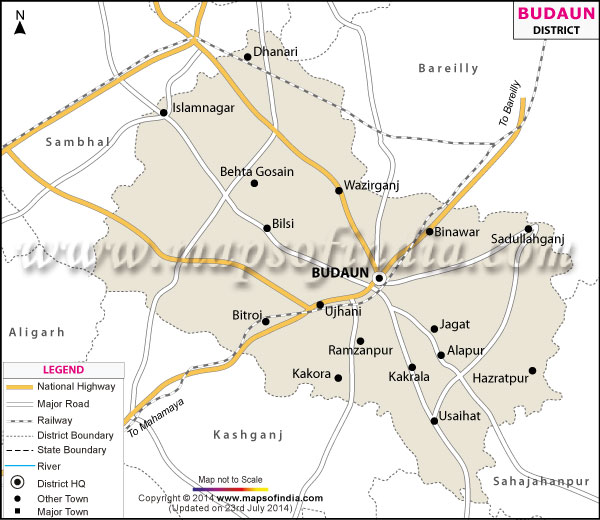
Budaun District (also known as Badaun District) is one of the districts of Uttar Pradesh in the Rohilkhand Division of the state and it was named after its headquarters town, Budaun, which has an oriental historical name, "Madinat-ul-Awliya" and is popularly called the "City of Saints" because of the many Sufi saints who lived, taught, and are buried there. Budaun town is also popularly known for its sweet pedas and in recent times as the 'Mentha City' of India for the extensive production of Mentha (mint oil).
Budaun town is located on the banks of the Sot River, which is a tributary of the Ganga and is about 27 km away from the Ganges and about 283 km away from Delhi, on the banks of the Ganga in the Rohilkhand belt of the western-to-central part of Uttar Pradesh. The city was said to have been founded in 905 AD according to the local tradition, but there are also references to an older, ancient settlement of about 220 BC. In 1801, the Nawab of Oudh ceded the district and its headquarters to the British government and Budaun became a town and district of British India in the Rohilkhand Division of the United Provinces.
History & Culture
The history of Budaun is very little known before the 11th century, but it flourished greatly during the Delhi Sultanate when the town became second in importance to Delhi itself as a seat of Islamic culture, scholarship, and political life. Early rule is attributed to various individuals including Raja Mahipal, but from the 12th century CE and later, there is more reliable historical evidence. Budaun was the birthplace of many political and military adventurers who, in the process went on to shape the history of the Indian subcontinent, and it was during this golden age that the most renowned architectural landmark of the city, the grand Shamsi Jama Masjid was built.
This mosque was built by Sultan Shams-ud-din Iltutmish in 1223 CE and now stands in the heart of the old city, having passed through the narrow alleys of the historic locality of Maulvi Tola, and is one of the oldest and most architecturally important mosques in India. Over the centuries, Budaun's reputation as the "City of Saints" is due to the many Sufi mystics who came to stay and were buried in the town, some of whom were associated with the wider Sufi tradition of Nizamuddin Auliya. There is also a tomb complex in the western part of the old city, where the graves of Makhaduman-i-Jahan (mother of a deposed Sultan), Sultan Alam Shah and his wife are believed to be located, which further adds to the city's association with the courtly history of the Sultanate era.
The cultural heritage of Budaun is also strong in modern India; the town can boast the name of Hindi cinema's most celebrated lyricist and poet, Shakeel Badayuni whose name and literary works are highly cherished and celebrated in the town where the iconic Shakeel Badayuni Road in the old city stands in his honor. The social and cultural life of the district today is a mixture of Sufi-Islamic culture, the Awadhi and Hindi-Urdu language culture and the old city of Budaun and its historic markets and neighbourhoods like Sotha, one of the oldest neighbourhoods in Budaun town. Today the town is very quiet and has a rather provincial character, but the district's culinary reputation, based on its renowned pedas, and its distinctly historical architectural heritage (ruins of the old Budaun Fort, landmark clock tower (Ghanta Ghar)) still draw visitors interested in this once powerful capital of the Sultanate.
Economy
The economy of Budaun is largely agricultural with its key contribution being aromatic crop and menthol production for India and its developing government and infrastructure.
Budaun town is the headquarters of the district, home to the office of the District Magistrate and other offices related to revenue, agriculture, rural development etc. In view of the mainly rural and agrarian population base of the district, Government employment is an important formal sector source of livelihood.
In the last few years, public infrastructure investment has also increased considerably in the district, including the recently launched Ganga Expressway, the longest expressway in Uttar Pradesh, which passes through Binawar in Budaun district, and is expected to greatly enhance the connectivity and access to the district for logistics. The district also has a strong public sector employment base with public healthcare and educational infrastructure such as the Budaun Medical College.
The majority of the services are concentrated in the town of Budaun and in other central places of the district like Ujhani, Dataganj, Bisauli, Sahaswan and Bilsi that act as service centres for the rural population of the area. Budaun serves as a key road hub for western Uttar Pradesh, where major highways connect the region with Bareilly, Etah, Mainpuri, Etawah and Shahjahanpur, fostering a burgeoning transport and logistics services industry.
In addition to these, agriculture is and has been the primary backbone of the rural economy of Budaun with the fertile plains of Rohilkhand and the Ganga and Sot rivers. The district is also known for its huge cultivation of mentha popularly known as 'Mentha City' of India and it is one of the largest producers of menthol oil (a major export as well as an industrial commodity) in the country. In addition to mentha, basic food crops, sugarcane, and other cash crops are commonly grown in the agricultural area of the District.
Tourism
In addition to its more modern cultural attractions, Budaun is also a place where early Delhi Sultanate Islamic architecture and its Sufi legacy can be seen at a glance.
Jama Masjid Shamsi, 13th century magnificent mosque built by Sultan Shams-ud-din Iltutmish in 1223 in the historic old city, is one of the oldest and most important preserved mosques from the early Sultanate period in India.
Budaun Fort (Ruins) — Ruins of the old fort of Budaun which gives a sneak peek into the town's fortified past as a seat of regional power. The city of Budaun, which is known as a City of Saints, has several popular Sufi shrines that reflect the city's history, such as Qadri Dargah.
Ghanta Ghar (Clock Tower) — One of the important old city landmarks in Budaun, which is also a popular tourist destination along with the Jama Masjid Shamsi and the Sotha area.
Sotha — An old residential area of Budaun, giving visitors a glimpse of the old city fabric and architecture of the city.
Shakeel Badayuni Road — A commemorative roadway which was named after the famous Hindi film lyricist and poet born in the city, of interest to visitors interested in the literary and film history of India.
Ganga Expressway (Binawar) – The expressway is mainly a landmark in the field of infrastructure, but the event of the expressway opening at Binawar has made it a visitor attraction, as it is the longest expressway in Uttar Pradesh.
Today, Budaun is not considered a major tourist attraction, but it attracts thousands of visitors each year, especially devotees and heritage enthusiasts, who visit the Sufi shrines and the few remaining buildings from the Sultanate period.
Demographics
The following are some of the important statistics of Budaun district from the Census of India 2011:
Population: 31,29,000.
Households: 615,776
Literacy Rate: 86.8% of the population is literate (2011)
Population Growth Rate (2001–2011): 20.96%
Sex Ratio: 871 females per 1000 males, which is less than the state average of Uttar Pradesh (912).
The number of children (0-6 years) is 664,909, which represents 18.06% of the total population.
Lower literacy rate of 42.03% overall (50.13% males & 32.73% females) among the lower literacy recorded in Uttar Pradesh
Scheduled Caste Population: 16.91% of the total population; the population of the Scheduled Tribe is negligible.
Rural-Urban Split: The number of people living in rural areas is around 46.32% (3,037,301 persons), while 52.34% (644,595 persons) are counted in some urban classifiable datasets (these should be checked against the official district census handbook as there is some variation between sources).
Both Budaun's relatively low literacy rate and sex ratio highlight the continuing socio-economic development challenges that have impacted the policy priorities in the district.
Administration
The administrative system in the Budaun district is as follows:
Tehsils: There are 6 tehsils in the district, Budaun having the largest area and population, Sahaswan being the smallest in population, and Bilsi the smallest in area.
Villages: Budaun District has about 1,785 to 2,061 villages spread over the tehsils and development blocks of the district, as per the sources consulted.
Towns: There are 23 towns in the district, of which the district headquarters is Budaun.
Legislative Constituencies: The district has Budaun City, a Lok Sabha constituency, and several Vidhan Sabha (state assembly) constituencies in the tehsils of the district.
District Leadership: The District administration is led by the District Magistrate, responsible for revenue, development and law and order activities in each Teara/Block of the district.
The administrative structure of tehsils helps the district administration to control the population of Budaun which is mainly rural and is spread throughout the villages in the town and bigger towns.
| Facts of Budaun District | |
|---|---|
| State | Uttar Pradesh |
| District | Budaun |
| District HQ | Budaun |
| Population (2011) | 3129000 |
| Growth | 19.95% |
| Sex Ratio | 871 |
| Literacy | 51.29 |
| Area (km2) | 4234.21 |
| Density (/km2) | 718 |
| Tehsils | Bilsi, Bisauli, Budaun, Dataganj, Sahaswan |
| Lok Sabha Constituencies | Badaun, Aonla (partly) |
| Assembly Constituencies | Badaun, Bilsi, Bisauli, Dataganj, Sahaswan, Shekhpur |
| Languages | Hindi, Urdu |
| Rivers | Ganga |
| Lat-Long | 28.130128,78.92498 |
| Travel Destinations | Jama Masjid, Hazrat Khwaja Nizamuddin Auliya's house, Choti Ziyarat, Badi Ziyarat, Banno Buwa Ziyarat, The palace of ohia, Sheikhupur Fort, Mumtaz Mahal's sister's mausoleum, Farshori tola, Kothiwal temple, Judge Saheb Ka Phatak, Dargah Alia Qadriya etc. |
| Government Colleges/Universities | Vivekanand College, N.M.S.N.Das P.G.College, Kedarnath mahila College for girls , Gindo Devi Mahila Maha Vidyalaya, Asim Siddique Memorial Degree College etc, |
FAQs
Q1: How many villages are there in Budaun district?
There are 1698 villages here.
Q2: What is the population of Budaun district?
As per the 2011 Census Budaun district has a population of 31,29,000.
Q3: What is the specialty of Budaun district?
Budaun was acclaimed as the historic ‘City of Saints' (Madinat-ul-Awliya), built by Sultan Iltutmish (1211-1211) in the 13th century, for its sweet pedas and being India's biggest ‘Mentha City' due to the production of menthol on a large scale.
Q4: What is the address of the district headquarters of Budaun district?
The headquarters of the district is in the town of Budaun, which lies on the banks of the Sot River some 27 km north of the Ganges and about 283 km south-east of Delhi.
Q5. In which year was Budaun established?
Local tradition has it that the modern city of Budaun was founded in 905 AD, while according to ancient records the same site was settled as far back as about 220 BC, and the district became British in 1801.
Q6: What percentage of people in Budaun district can read and write?
Overall literacy rate of Budaun district is 42.03% (males-50.13% and females-32.73%) as per Census 2011, which is one of the lower literacy rates in Uttar Pradesh.
Q7: What is the gender parity in the case of Budaun district?
The sex ratio in Budaun district is 871 females per 100 males, which is lower than the Uttar Pradesh sex ratio (912) as per Census 2011.
Q8: What are the sectors of the economy of Budaun district?
Agriculture, especially mentha (mint/menthol) farming on a large scale, is the main economic activity of the district, while trade, transport and development of infrastructure are secondary, with the Ganga Expressway emerging as another major infrastructure investment.
Q9: The architect of Jama Masjid Shamsi, Budaun?
Jama Masjid Shamsi was constructed in 1223 CE by Sultan Shams-ud-din Iltutmish, and is one of the earliest surviving mosques of its size in India.
Last Updated on : November 13, 2026
