






Introduction
Maharajganj was formed in 1989 from Gorakhpur. Agriculture is one of the major activities with rice, wheat, and sugarcane dominating everyday life. Everyday life is also facilitated by the farming of land which is nourished by rivers and streams that flow ceaselessly. The people possess rich simple traditions, and speak festively, and with great enthusiasm in the Hindi and the Bhojpuri dialects. The district is not heavily industrialized. However, the life and the culture of the people resemble that of the Eastern UP villages.
History
The district’s location and its rich heritage made it an important place in history as monks throughout the ages and major civilizations that practised Hinduism and Buddhism made their way to the region to establish their ideologies and trade routes. The Hindu and the Buddhist philosophies made their way to the region, which made the district an area of prosperity. The Medieval ages saw developments in the district as it fell under the influence of different kingdoms in Eastern Uttar Pradesh.
Local landlords and chieftains emerged in the area who controlled the agrarian land and dominated the villages. With the expansion of the Delhi Sultanate and Mughal Empire, administrative systems of higher order were overlaid over Maharajganj. The Mughals promoted agrarian economy and trade, the empire’s economy thus profited from the agrarian land of the city.
The area sustained flourishing temples, shrines, folk practices, and traditions along with the intertwining of the local traditions with the rest of the world. The 18th and 19th century British presence started a new era in Maharajganj. The colonisers reorganised the administrative land revenue systems which impacted the land-owning and agrarian classes. Colonial land revenue systems from the British administrative centre in Gorakhpur, impacted it directly.
During the freedom struggle, the people of the region participated in movements against British rule, inspired by leaders from the contiguous regions. Local agrarian classes and the district’s nationalist inclination from the rest of Uttar Pradesh joined the ongoing agitations. The period of struggle demonstrated the people’s spirit to preserve their identity and to fight for their freedom.
Although Maharajganj obtained its official status as an administrative district in 1989, it has earlier origins that date back to the first year of independence for India in 1947. Following independence, the region experienced an agricultural boom which sustained the economic growth of the region. Along the Ghandak River, the cultivation of rice, wheat, and sugarcane is predominant. With the district's closeness to the Nepal border, the district has been greatly influenced by Nepal due to trade and transient people.
Gradually, over the years, systems of trade, schools, and health care systems were constructed, and integrated, but the problem of poverty and underdevelopment still perpetuated. The district has presided over a culture that has transformed folk music and celebrations into a more recent and modernized derivative. The spread of Buddhism from Kushinagar, the legacy of Hindu practices from the middle ages, and the strategic struggles of the colonial era all add to the district’s culture.
Maharajganj is a region with rich modern and ancient heritage, is a unique blend of old and new, and of history and modern times. The past history of the district consisting of ancient kingdoms, and of colonial and post independence struggles reflects the integrated and blended social fabric of the people and the district, of the resilient folk, and farming communities who have adapted to the modern changes and preserved their rich heritage.
Culture
While reflecting the traditions of Purvanchal, Maharajganj, an eastern district of Uttar Pradesh, has its own unique cultural identity as well. The community thriving in the district is agrarian, where farming is more than an occupation, but extends to their festivals, food, social customs and the community's daily rhythm of life.
The cultural identity of the district is embedded in community folk music, dance and story telling. Everyone rejoices in the singing of the popular Bhojpuri songs, be it for weddings, local get together's, or songs of the harvest. The dholak and harmonium ensembles revive the songs of the community. Also, with the community's folk songs, the expressive folk dance is the true decoration of festivals like Holi and Diwali.
The community holds on to the old folk and oral traditions that keep stories, wisdom, and even humor, while it pays tribute to and reuses an old (and new) source of entertainment for the community. Considerable amount of joy and celebration is present in the community during the religious and social rural festivals of Holi, Diwali, Chhath Puja and Makar Sankranti. Devotees especially pray to sun gods and perform rituals during Chhath Puja at the banks of rivers and ponds.
In different ways, the area has multiple, interconnected spiritual links with nature, community, and the cosmos. Most of the foods prepared in the region of Maharajganj are from local and seasonal resources. They are also simple in design and execution, and very rich in complexity of flavors. Meals consist of the same staples, rice, wheat, pulses, and seasonal vegetables, but there are local intricacies. During the local festivals, kheer, litti-chokha, and puri-sabzi are prepared. Meals of food are shared and considered hospitable.
Rich cultural and religious practices thrive from and in the local temples and shrines that add to the local social center. Many come to worship and also to socialise and witness the folk performances, and purchase handicrafts and local food at the fairs and melas.
Language
The languages spoken in Maharajganj are very interesting and show the diverse cultures present in the region of Uttar Pradesh. People usually converse in not one but multiple languages. They actively switch between languages during the conversations. Language is an important artifact of identity and the culture of a community, and in the case of this city, the majority of the population are Hindi speakers.
Hindi is used in educational institutions and in administrative offices. It is also the language of the newspaper and people use it to communicate. It is expected that the majority of a given population in a country is fluent in a given language, and in the case of India, this is also true for Hindi.
Due to the district's location near Nepal you can hear some words being spoken. People near the border often talk to traders and visitors from Nepal. As a result some Nepali phrases have become familiar to locals. In addition to these languages some people also speak Urdu. You will often hear Urdu in markets and, at home, where families have used it for a time. People also appreciate Urdu for its poetry and literature. Bhojpuri is another language that people usually speak.
Geography
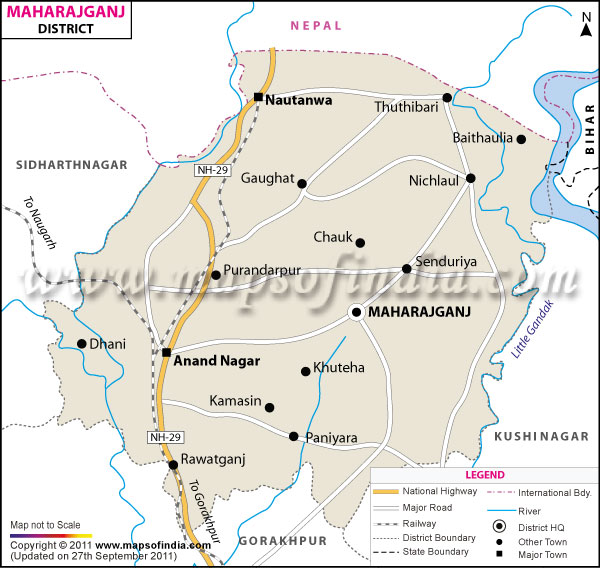
The geography of Maharajganj is really defined by where it's. It is in the north- part of Uttar Pradesh right next to the international border with Nepal. It is in the plains of northern India. These plains are a part of the Gangetic plain. Because it is located here the land is pretty flat. This makes it perfect for growing crops. You see fields over the countryside.
The rivers which flow through the city have made the soil fertile over time, particularly alluvial soil is found here. It helps in the growing of crops like rice and wheat. Farming plays an important role in the economy of the region. Since the majority of the places are fields, farming remains the major activity of the region.
The rivers and streams originating in the hills are important to the farmers in the district. They provide water that is important for the irrigation of their crops. Rapti river is an important river that flows through this city. During the monsoon season the tributaries of the Rapti River are at peak and water flows constantly from the foot of the Himalayas. The river water helps to recharge the ground water table.
The farmers of the subtropical belts of the Maharajganj district have to endure extremely high summer temperatures, a monsoon season with heavy downpours and a winter season with cooler temperatures. This region is also influenced by the foothills of the Himalayas and the changing patterns of the wind. The months of April to June are the peak of the dry monsoon season. During this period temperatures can rise above 40 degrees celsius.
Monsoons begin to rain in the last of June and continue to pour as the temperature drops. The average rain in the monsoon season is 1100mm which helps crops grow. The winters are from November to February. The weather can drop to 4 degree celsius. The region gets a lot of sunshine but the rain season's humidity peaks.
| Facts of Maharajganj District | |
|---|---|
| State | Uttar Pradesh |
| District | Maharajganj |
| Location | North-East Uttar pradesh |
| District HQ | Maharajganj |
| Population (2011) | 2684703 |
| Growth | 23.50% |
| Sex Ratio | 943 |
| Literacy | 62.76 |
| Area (km�) | 2952 |
| Density (/km�) | 903 |
| Tehsils | Maharajganj Sadar, Nautanwa, Nichlaul, Pharenda |
| Lok Sabha Constituencies | Maharajganj |
| Assembly Constituencies | 5-Maharajganj, Nautanwa, Paniyara, Pharenda, Siswa |
| Languages | Hindi, Bhojpuri, Urdu |
| Rivers | Gandak |
| Lat-Long | 27.112923,83.503933 |
| Travel Destinations | Lehara Durga Mandir, The Sohagi Barwa Wildlife Sanctuary etc. |
| Government Colleges/Universities | Rajiv Gandhi Degree College, Akshaiber Singh Memorial Post-Graduate College, Dr. Ram Manohar Lohia Mahavidyalya, Paramhans Pal Mahavidyalya, Lt. Bhagwant Ptael Panmati Devi Mahavidyalya, Jawaharlal Nehru Smarak P.G. College, Swarn Prabha Mahila Mahavidyalaya Etc., Swarn Prabha Mahila Mahavidhyalya etc. |
FAQs
Q1: What is the district famous for?
Maharajganj is famous for its sugarcane farming, its rich plain soil, and its busy border town Sonauli, one of the major crossing points between Nepal and India.
Q2: What is unique about the culture of the region?
The culture is an amalgamation of the Awadhi and the Bhojpuri cultures. The district is rich in culture due to its folk songs, and celebrations of the festivals of Holi, Chhath and other local fairs.
Q3: What kind of food is popular in Maharajganj?
Food culture is simple, but with flavors that will keep you returning to try more. Dal, roti and seasonal vegetables are the common food options, with snacks like samosas and jalebis being popular especially in the ringing market.
Q4: How does the Indo-Nepal border influence life here?
The Sonauli border means there are always traders, travellers and tourists, creating a very busy market with trade on both sides. Because of this, it is a market and a place for the fusion of Indian and Nepali cultures, impacting the region economically as well as socially.
Last Updated on : May 08, 2026
