




Introduction
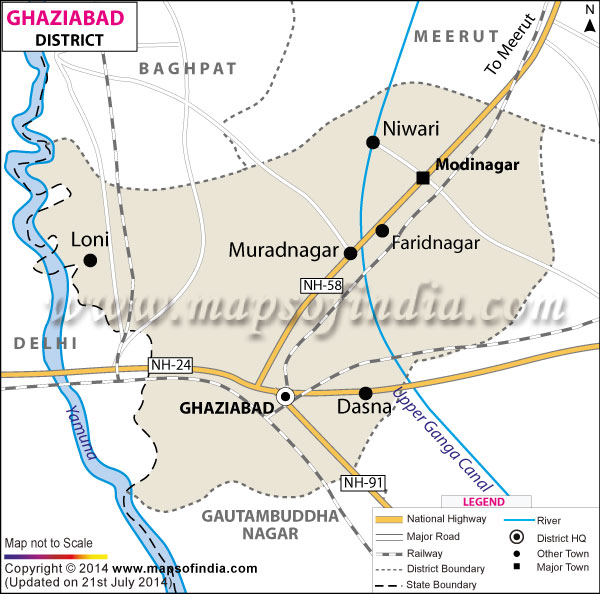
Ghaziabad district is one of the largest and fastest developing urbanising district of the northern Indian state of Uttar Pradesh, clearly visible on the ghaziabad district map. It is a part and parcel of the National Capital Region and is located just east of New Delhi, clearly visible on the ghaziabad district map and serves as an essential residential, industrial and commercial outgrowth of the national capital. The district is a vibrant mix of ancient village settlements, growing townships and industrial estates that are both classic elements of North Indian and new urbanism.
History
The area today known as Ghaziabad district has a very old history associated with the overall cultural and political progressions in the northern part of India. The surrounding archaeological evidence indicates that habitation has taken place since ancient times because the district area is in the fertile plains between the rivers Ganga and Yamuna. The place it was in made it close to historic trade and invasion routes which connected the north-western frontiers of the subcontinent to its Gangetic core.
After a dashing nobleman named Ghazi-ud-Din who worked in the Mughal court, the present town of Ghaziabad was established in 1740. In the eighteenth century as the Mughal power waned, the area witnessed changing political control, such as the time under the influence of Maratha before its ultimate inclusion in the British territories in the early nineteenth century.
Ghaziabad became significant under the British at the time due to the positioning along the new railway and road systems. This was reinforced by the construction of railway lines in the nineteenth century that made it an important point of interface between Delhi and the cities to the east like Kanpur and Allahabad. Agriculture was still the major occupation of most of the people though there was a slow emergence of small-scale industry and trade.
It also contributed to the proceedings of the Indian Rebellion of 1857 when revolts of the neighboring Meerut and Delhi echoed throughout the district. Ghaziabad grew steadily after 1947 when it gained independence especially after the growth of Delhi. The second half of the twentieth century saw the development of industrial units and the city is now known as the Gateway of Uttar Pradesh due to its positioning on the border of the national capital. Over time, administrative reorganisation formed the boundaries of the district to the present, dividing the district with the other neighbouring districts like Gautam Buddha Nagar and Hapur.
Over the past decades, the economic and demographic profile of Ghaziabad has changed considerably due to the rapid urbanisation, creation of expressways and the admission of Ghaziabad to the National Capital Region planning grid. Large residential colonies, commercial complexes and learning institutions have spread making the district one of the most populated urban centers in Uttar Pradesh.
Culture
The culture of the Ghaziabad district reflects the fact that it is a place of overlapping country tradition and urbanity. Majority of the population subscribe to Hinduism and Diwali which are celebrated along with Navratri and Dussehra among the neighbourhoods and housing societies. Eid al-Fitr and Eid al-Adha are celebrated by Muslim people using the same spirit which contributes to the shared calendar of festivity predetermining the social life of the district.
Older practices related with weddings, harvest and religious practices are still practised especially in more traditional places and in some of the rural areas. Meanwhile, the migration of people of various regions of India has brought diversity to the cultural environment. The inhabitants of different states introduce different cuisines, dialects and manners and therefore a cosmopolitan environment exists in most portions of the district.
The urban culture of Ghaziabad is highly related with the culture of Delhi. Cinemas, restaurants and cultural centres, shopping centres serve a contemporary lifestyle and the traditional bazaars and markets uphold the old forms of trade. The colleges of engineering, the management institutes and schools of the national boards, the cultural programmes, debates and festivals in the educational facilities promote the intellectual and artistic life.
Music and cinema dominate the center stage of leisure activities and both the hindi popular culture and regional influences have an effect on the choices of entertainment. The neighbourhoods interact with each other when they visit parks, community centres and religious institutions where they engage in civic activities. Even though it is expanding at a fast rate, the inhabitants remain close to their ancestral villages in western Uttar Pradesh and this has kept to the inclusion of the fact that the city still has some village life that defines its urban living.
Language
The official language in Ghaziabad district is Hindi and is applied in government administration, education and in everyday communication. The spoken form used is mostly affected by the Khari Boli of western Uttar Pradesh and the same is the foundation of standard Hindi. In non-academic contexts, local dialects and phrases are manifestations of the language tradition.
The Urdu language is spoken and comprehended by part of population and especially in the Muslim community and is used in the culture and religion. In some districts, in some locations, bilingual signs and publications in Hindi and Urdu are widespread. In higher education, corporate jobs and official documents, where it has played a significant role, English is the language of the district which has been incorporated into the National Capital Region. Most people in the professional community are English speakers, but Hindi is the major and main language of social interaction.
Migration has brought new languages to the district such as Punjabi and other local languages but these are utilized in the circles of the communities. In general, the linguistic environment of Ghaziabad both represents the history of western Uttar Pradesh and is an effect of cosmopolitan tendencies of its urban environment.
Geography
Ghaziabad district is situated to the West of Uttar Pradesh , clearly visible on the ghaziabad district map, and also it borders the National Capital Territory of Delhi. According to the Uttar Pradesh map, Ghaziabad occupies a significant position in the western region of the state, reflecting its geographical importance as a major urban and industrial district. It is located in the upland Gangetic plain that is flat and possesses fertile alluvial land. The area is surrounded by two rivers, i.e. Yamuna and Ganga, though none of the rivers passes through the central city. The Hindan river that is a subsidiary of the Yamuna runs through the district and has customarily promoted focus and agriculture.
It is also the topography which is mostly level and thus can be utilized in cultivation as well as development. Prior to the vast urbanization, the local economy relied on agriculture, since there was a farm produce of wheat, sugarcane and pulses in the country. Agriculture activities remain ongoing in the peripheral regions, whereas in majority of the regions, urban sprawl has reduced the reduction of agricultural lands.
The climate of Ghaziabad may be characterised as a wet subtropical climate. The summers are between April and June and are hot and dry and the temperature would usually be above 40 degrees Celsius. The monsoon winds come at the end of June and last till September and are the source of the rainfall during the year. Winters, between December and February are cool and are sometimes characterized with fogs especially in the early mornings. Variations in seasons affect daily living programs, construction and agricultural programs.
The geography of the district is characteristic of transport infrastructure. The area is traversed by major highways such as those that connect Delhi and eastern Uttar Pradesh. Ghaziabad is also strategically located by railway lines which connect it to the major cities in the north of India. The connectivity and commuting has also been enhanced by the extension of metro rail services in parts of the District, which previously had no access to the Metro Rail.
The landscape of urban development has developed a situation dominated by residential township, commercial complex and industrial estate. Planned housing colonies mix with older settlements and green spaces and parks offer recreational spot in the highly populated neighbourhoods. Other issues that the policy seeks to focus on in order to manage the urban environment sustainably include environmental issues like air pollution and river pollution.
Besides the natural location, geography of Ghaziabad is heavily influenced by the fact that Ghaziabad is a transitional zone between the National Capitol Territory of Delhi and the inner districts of western Uttar Pradesh. This location has led to widespread peri-urbanization in which formerly agricultural villages have been slowly amalgamated together into continuous urban-settlements. Proposed projects like residential townships and industrial belts have changed the land-use pattern forming a mosaic of high-density housing, commercial complexes and the left-over agrarian patches. This closeness to the city of Delhi has also had an effect on commuter trends, as a large percentage of the population are now commuting to and out of the district and state borders in order to work every day.
Another geographical aspect of the district of importance is water resources and environmental management. Irrigation was historically supported by the Hindon River and a network of interconnected canals, however, the rapid industrialisation and rise in population put pressure on the groundwater and the quality of the surface water. During the monsoon season, there is need to manage urban drainage systems, flood plains and low areas to avoid waterlogging. With Ghaziabad ever growing, sustainable planning, which will accommodate development of infrastructure without compromising the ecological elements, is a geographical issue of prime concern to the district.
| Facts of Ghaziabad District | |
|---|---|
| State | Uttar Pradesh |
| District | Ghaziabad |
| District HQ | Ghaziabad |
| Population (2011) | 3,343,334 |
| Growth | 42.27% |
| Sex Ratio | 881 |
| Literacy | 78.07 |
| Area (km2) | 1034 |
| Density (/km2) | 3967 |
| Tehsils | Ghaziabad, Modinagar |
| Lok Sabha Constituencies | Meerut (shared with Meerut district), Ghaziabad |
| Assembly Constituencies | Dholana, Gaziabad, Loni, Modi Nagar, Muradnagar, Sahibabad |
| Languages | Hindi, Urdu |
| Religion | Predominantly Hinduism |
| Rivers | Hindon |
| Lat-Long | 28.668299,77.452826 |
| Travel Destinations | Mohan Nagar Temple, Ram Manohar Lohia Park, Indira Priyadarshini Lake, Swarn Jayanti Park, Laxmi Narayan Mandir, Devi Maha Maya Mandir, Loni Hanuman Mandir, April Park, Prachin Hanuman And Khatu Shyam Baba Temple, Mokshdhaam Temple etc. |
| Government Colleges/Universities | Multanimal Modi Post-Graduate College, Modi Science & Commerce College etc. |
FAQs
Q1: Why does Ghaziabad play a key role in the National Capital Region?
It’s near to Delhi which makes it an important residential, commercial and industrial hub. Many people in Ghaziabad commute daily to the city for work and business.
Q2: Which industries do we see in Ghaziabad?
In the district’s main industries we see engineering, electronics, automobile components, steel, manufacturing, construction materials and IT to be included.
Q3: Is Ghaziabad only an industrial city?
No. Industry is a key component of our area, of which we also have large residential areas, extensive educational institutions, shopping centers, parks and those which are in the process of developing into commercial zones.
Q4: Which languages do people usually speak in Ghaziabad?
Hindi is the primary language of day to day communication. Also very wide spread is Urdu, at the same time English is very much in use in education, business and corporate settings.
Q5: Does farming still contribute to Ghaziabad’s economy?
Yes. Although urbanization has grown at an incredible rate farming still takes place in outlying areas which produce grains of wheat, sugarcane and vegetables.
Q6: Why do so many people choose to live in Ghaziabad?
People go for Ghaziabad which has better housing options, great transport and educational infrastructure and also is very accessible to Delhi at much more affordable prices.
Last Updated on : July 23, 2026
