

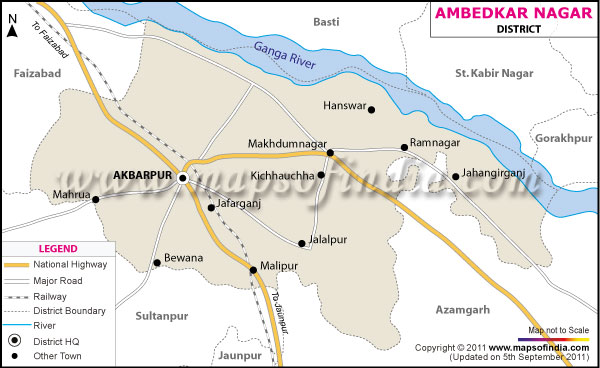





About
Ambedkar Nagar District is one of Uttar Pradesh's 75 districts in the state's north-eastern part and part of the Ayodhya (formerly Faizabad) Division and it is one of the most significant names in UP history as it was named after Dr. Bhimrao Ramji Ambedkar, the principal architect of the Indian Constitution and a crucial figure in the social justice movement in India, who worked tirelessly for the benefit of deprived classes, women and other weaker sections of society. The name itself by then Chief Minister Mayawati, represents the identity of the district as a symbol of social empowerment on the Indian administrative map.
The district was formed on 29th September 1995 from the erstwhile Faizabad district with its HQ at Akbarpur that is a historically significant town 180 km away from Lucknow and 60 km away from Ayodhya which is the birthplace of Lord Ram and it has an area of about 2,350 sq. km and is situated in the fertile Ganga basin of the central part of the district with alluvial soils which are suitable for intensive agriculture and is bordered by Basti and the Sant Kabir Nagar to the north, Gorakhpur district to the north-east, Sultanpur district to the south, Ayodhya district to the west and Azamgarh to the east.
History & Culture
The modern history of Ambedkar Nagar started in 1995 when it was carved out from the erstwhile Faizabad district as a separate political and developmental entity and kept in mind the significance of Dr. B. R. Ambedkar's contribution to social reform movements in Uttar Pradesh. The socio-economic problems that the district has aimed to solve since its formation were highlighted by the declaration of the district as one of the identified backward districts according to the Backward Regions Grant Fund Programme by the Ministry of Panchayati Raj in 2006.
The district's cultural and historical heritage is much deeper, however, than its administrative creation. The district headquarters of Akbarpur is the birthplace of one of the most prominent socialist political leaders and freedom fighters of India, Ram Manohar Lohia (1910–1967), who influenced political discourses in the region. The district is also the birthplace of the first woman amputee to climb Mount Everest—Arunima Sinha—and her achievement has been a great boon to the pride of the district.
The district is rich in religious and spiritual heritage found at the heart of the district's identity. The shrine of the 13th-century Chishti Sufi saint Ashraf Jahangir Semnani is situated at Kichhauchha Sharif (also spelled Kicchocha Sharif) some 25 km away from Akbarpur and is visited by devotees from all creeds, castes and communities with a syncretic tradition of worship that cuts across religious lines. In addition to that, there are a number of local temples in the district, which attract devotees year-round, such as the Mahadev Mandir at Beedi village, Maa Gaytri Shakti Peeth, Shree Baram Baba Mandir and Maa Kalika Mandir. The district is home to more than four-fifths of the population who practice Hinduism, and a large Muslim population, thus showcasing the religious and cultural diversity that exists in eastern Uttar Pradesh in terms of festivities, fairs and common pilgrimage practices.
Economy
Ambedkar Nagar is a place with a strong agricultural economy, a significant textile and industrial sector, and an emerging government and public sector.
Agriculture Sector: Akbarpur is the agricultural hub of the district, which has various departments including Agriculture, Livestock, Agriculture Extension, Animal Science, Dairy Science, Food Science and Technology, Agricultural Engineering, Fisheries, and Forestry. The district administration, led by the Deputy Commissioner, has the responsibility of overseeing development programmes, especially as Ambedkar Nagar is classified as a backward region and is thus eligible for central and state government financial assistance for its development.
Public Sector: The district has good infrastructure in the public and quasi-public sectors, comprising the NTPC (National Thermal Power Corporation) power plant near Tanda, which is one of the larger power generation plants in the region, and a government sugar mill at Mijhaura. Educational infrastructure comprises the Rajkiya Engineering College, Ambedkar Nagar, and a government medical college at Akbarpur, which are working in the public sector and developing skills in the region.
Services Sector: The tehsil towns of Akbarpur and the rest of the district, Tanda, Jalalpur, Alapur and Bhiti, are commercial hubs for the rural population and are home to a concentration of services, such as trade and transport and healthcare services. The plastic industry is another addition to Akbarpur's services and small industries, along with the processing of farm products.
In addition to these areas, the district is well known for its textile industry, with its hub in the town of Tanda, which is known for its handloom and powerloom cloth called Tanda Terricot, which has contributed to the distinctive position of the district in the traditional weaving economy of the country. Agriculture, besides textiles, is the main source of livelihood for a vast majority of the rural population of the district, with the fertile alluvial soils of the Ganga basin and the Saryu (Ghagheera) river on the northern boundary of the district. The cement production industry also serves the district, which is completed by a certain degree of organization of industry in the more or less traditional agricultural society.
Tourism
There are Sufi and Hindu places of pilgrimage, historical sites and riverside locations in Ambedkar Nagar, which attract a significant number of domestic tourists each year – more than 641,000 domestic tourists were recorded visiting the district's attractions in 2021 alone.
Kichhauchha Sharif (Ashrafpur Kichhauchha) — One of the most revered pilgrimage sites of the district, visited by followers of various religions all year round, the shrine (dargah) of the 13th-century Sufi saint Ashraf Jahangir Semnani.
Govind Saheb — A historical and religious site of the district, often quoted with Kichhauchha Sharif as one of the most popular tourist spots in the district.
Sihmai Karirat — 5 km away from the district headquarters a local tourist site of historical and scenic value.
Mahadev Mandir, Beedi Village — It is one of the most important Shiva temples, which attracts devotees from all over the District.
Maa Gaytri Shakti Peeth: It is one of the important Shakti temples that is visited by devotees, mainly during the festivals of major Hindu deities.
Additional temples of local religious importance (Shree Baram Baba Mandir, Maa Kalika Mandir): Regular pilgrim traffic all year round.
The district headquarters, Akbarpur, birthplace of socialist leader Ram Manohar Lohia and Everest climber Arunima Sinha, besides being a place to visit for its markets, educational institutions, local history, etc.
Shravan Kshetra (Sharwan Chetra) — A historically noted place in the district, where they have their local legend and tradition.
These sites constitute a quiet, steady pilgrimage and heritage tourism hub for Ambedkar Nagar which attracts mostly pilgrims and tourists from the surrounding Awadh region.
Demographics
As per the Census of India 2011 Ambedkar Nagar district has the following statistics:
Population: 2,397,888 (1,212,410 males and 1,185,478 females) and ranks 186th among India's 640 districts by population
Households: 368,728
Very rural or very urban: The overwhelming majority of the population is rural (2,117,158 people, approximately 88.3%), while only 280,730 people (about 11.7%) live in urban areas.
Total Child Population (0-6): 339,229 people (around 14.15% of total population)
Language: The main religion is Hinduism of which 1,985,654 people are members (82.81% of the population) and there is a sizable Muslim minority, which accounts for the rest of the population.
Languages Spoken: Hindi and Awadhi are the most commonly used languages in the district with Hindi being the language used for administration.
The district literacy percentage is also unknown, ranging from approximately 65-70% based on district handbook data available from the last official handbook; it is recommended to consult the district handbook for the most up-to-date figures. The population increase and demographic profile of Ambedkar Nagar in Uttar Pradesh are typical of the densely populated agriculture-based districts of the eastern part of the state.
Administration
Ambedkar Nagar district has the following administrative structure:
Tehsils: The district has been bifurcated into 5 tehsils: Akbarpur, Tanda, Jalalpur, Alapur and Bhiti, which are revenue and administrative subunits of the district.
The district is predominantly rural and has a total of 1,757 villages distributed amongst its five tehsils.
Ambedkar Nagar contains 7 towns, of which Akbarpur is the district headquarters.
Legislative Constituencies: The district lies under Ambedkar Nagar Lok Sabha and Sant Kabir Nagar Lok Sabha, with the assembly segments of Katehari, Jalalpur and Akbarpur coming under Ambedkar Nagar Lok Sabha and the Alapur assembly segment is under Sant Kabir Nagar Lok Sabha.
District Leadership: Administration of the district is under the control of a District Magistrate with the revenue, development and law and order departments.
This tehsil-based administrative system is consistent with the already adopted system in other parts of Uttar Pradesh which allows the district administration to have a large population, which is largely rural, spread out across five tehsils and many villages.
| Facts of Ambedkar Nagar District | |
|---|---|
| State | Uttar Pradesh |
| District | Ambedkar Nagar |
| District HQ | Akbarpur |
| Population (2011) | 2397888 |
| Growth | 18.30% |
| Sex Ratio | 978 |
| Literacy | 72.23 |
| Area (km2) | 2530 |
| Density (/km2) | 1021 |
| Tehsils | Akbarpur, Allapur, Bhiti, Jalalpur, Tanda |
| Lok Sabha Constituencies | Ambedkar Nagar and Sant Kabir Nagar (Rajesultanpur, Alapur, Kalilabad, Mehandawal) |
| Assembly Constituencies | Akbarpur, Alapur, Jalalpur, Katehari, Tanda |
| Languages | Hindi, Awadhi |
| Rivers | Saryu |
| Lat-Long | 27.459539,83.138237 |
| Travel Destinations | Kichaucha Sareef, Dr. Ambedkar Park, Guru Gobind Sahab etc. |
| Government Colleges/Universities | Mahamaya Rajkiya Allopathic Medical College, Manyawar Kanshiram Engineering College Of Information Technology, Ramabai Government Women Post Graduate College, Sljb Pg College, Gsic, Rajesultanpur Group Of College, Rmrs Pg College etc. |
FAQs
Q1: How many villages are there in the district?
There are 1757 villages in the district.
Q2: How many people are there in Ambedkar Nagar district?
As per the 2011 Census Ambedkar Nagar district has a population of 2,397,888 comprising 1,212,410 males and 1,185,478 females.
Q3: Ambedkar Nagar district is famous for which?
Tanda Terracotta textile industry, Kichhauchha Sharif – Sufi shrine of Ashraf Jahangir Semnani, Ram Manohar Lohia (socialist leader) and Everest climber Arunima Sinha are all reasons why A is famous.
Q4: In which district is Ambedkar Nagar headquarters?
Akbarpur town is the headquarters of the district which is about 180 km from Lucknow and 60 km from Ayodhya.
Q.5 In which year was Ambedkar Nagar district established?
The district was formed on 29th September 1995 out of the erstwhile Faizabad district and renamed after Dr. B. R. Ambedkar.
Q6. What is the literacy rate of Ambedkar Nagar district?
Literacy rates range from source to source as do the district figures, which put the overall rate between 65% and 70% but should be checked against the latest official district handbook.
Q7: Which are the industries contributing to the economy of Ambedkar Nagar district?
The economy of the district is based on the textile industry of Tanda, agriculture, the TNPCL power plant, the sugar mill at Mijhaura, the cement industry and the small plastics industry at Akbarpur.
Q8: Why was the district named Ambedkarnagar?
The district was named after Dr. Bhimrao Ramji Ambedkar in honour of his contributions towards the development of the deprived classes, women and other weaker sections of society.
Last Updated on: November 13, 2026
