






Introduction
Kaushambi, a district of Uttar Pradesh, draws along the banks of the Yamuna River, narrating tales of the imprints of time hidden in the vast Gangetic plains. It was the capital of the Vatsa kingdom aka Kosambi which even attracted Buddha to come and preach under the tree. The district is marked by rural life, the mustard fields swaying in the monsoon, villages sprouting around tube wells with Manjhanpur being the nucleus. The district is encompassed by the sand of Prayagraj to the east and the bends of Fatehpur to the west.
The summers are extreme, followed by what can be termed as foggy winters, and the monsoons which cause floods. Such is the extreme climate of this region which adds both advantages and disadvantages to the seemingly endless stretch of fertile soil. The dialect here is a version of Hindi with a heavy Awadhi influenced accent. This is very similar to what is used in conversational speech during festive occasions like Holi, Chhath Pooja, and Ramlila (that’s a Hindu festival play) as well. People in this region are farmers and cultivate wheat, rice as well as pulses. The ancient brick stupas at Kosam are a reminder of the connection between the ages.
History
The numerous tales and historical remains of the diverse elements that have sustained Kaushambi's evolution over the centuries can be compared to the patterns formed by the roots of a dying tree. Situated at the confluence of various spiritual practices and trade routes, it was the Vatsa Kingdom's capital and an important place for commerce. Notable relics such as the buried parts of the stupas and the ancient walls of the city of Kosam, testify to the city's great historical value.
It is documented that Kaushambi was named after a prince by the name of Kusamba.
He was said to be the son of one of the Chedi kings, Uparichara Vasu of the Mahabharata or Kusha of the Ramayana. The Puranas indicate that King Nicakshu, after the great floods that destroyed Hastinapur, moved the Kuru capital to Kaushambi. The fact that it was the center of trade within the routes of the Succession War emphasizes the importance the lineage of the Pandavas placed on Kaushambi.
Kaushambi in Udayana's time was the capital of the Vatsa kingdom and one of the largest cities in India in the BCE centuries. Udayana was known to be fond of the Buddha. He was a great warrior and could ‘make it rain’ by shooting arrows. Buddha had visited Kaushambi several times and had preached at Ghosa's mango grove where he settled a dispute between two monks and left some monks at a monastery. He was also mentioned in the dramas and ancient texts called Priyadarsika.
There Udayana was described as a great warrior who conquered the Avantis Pradyota and had a hilltop palace from which he ruled and where the ruins are said to be today. All this was made possible due to trade. Being situated on the Ganges Plain it had a network of rivers and great overland trade routes which made it a great hub of trading in spices, silk, and metals.
The coins and artifacts from the Mauryan Empire confirmed the Mauryan’s control of the region after the Nanda Empire. By the 7th Century CE, with the rise of Harsha at Kannauj, the region began a period of decline. A series of Muslim conquests of the 12th Century CE devastated the region and it became, by the early Modern period, a small settlement of Kosam amidst the extensive archaeological remains.
Excavations at Kosam showed an apparent decline of material culture after 600 CE with a notable degradation of the quality of pottery. Kosam has remaining archaeological evidence that includes a large stupa, an Ashokan pillar, inscribed bricks, and a series of seals inscribed with the name Kosambi. During the 18th and 20th centuries CE, the British surveyed and mapped the settlement and the Archaeological Survey of India excavated and surveyed the remains.
Culture
Kaushambi represents a variety of cultural synthesis of two or more cultures. It has been a crucible for merging social structures and ideas of Jainism, Buddhism and Hinduism, which have, throughout the social history of the Indian subcontinent, been practiced in the region and are now part of the customs, rituals and festivals of the contemporary people. The region is described in the two great epics of ancient India, the Mahabharata and the Ramayana.
The rich history of the region still provides the basis for many people’s perception of their history and heritage. The fusion of various traditions strengthens the sense of belonging among the people of the region. A good example of this is the celebratory and grand events that commence the different religious observances and festivals including but not limited to Holi, Diwali, Eid, Chhath Puja, and Dussehra. Most people close to the roads of the villages witness prayer rings, fair-like markets, and holy sounds of music and worship.
When Dussehra comes, Ramlila is performed, where parts of the Ramayana are enacted, are things many people look forward to. The Kaushambi Mahotsav brings people of the region together with some cultural and devotional songs, and dances. Other than that, during Holi and Teej many women are seen singing and dancing. The atmosphere created by the dholak, tabla, and harmonium is very nice.
Numerous songs describe farming seasons, aspects of family life, and worship of gods. Poetry and storytelling are even preserved and relayed through the local dialects, like the Awadhi and Hindi, and even the storytelling of the dialects is preserved through the increasing modernity of the local storytelling devices. The omnipresent lifestyle is inextricably linked with the agrarian lifestyle, with the farming families resulting in their daily rituals being structured around the rhythm of the seasons and the cycle of the crops.
The rural outfits continue to be traditional, with men being in dhoti ,kurta and women being in saree or salwar-kameez. During the time of the festival and the commencement of the family, the food containing the sweet material is containing the food in more than the hand of the same and the hand of the same.
Language
The language used in Kaushambi reflects people's lives daily, influenced by history, movement of people, and nearby regions. A majority of residents in the district communicate in Hindi, the official language of schools, government offices, and even public signage. However, the Hindi they speak is of course a lot different than the book version, and is influenced by the local dialect and the language of the villages.
There are phrases that to a non Awadhi speaker may sound difficult. Dialects, and Awadhi of course, is the language of choice in the home, the market, and the social, informal setting of every small group. It is personal. It is familiar. The speech in the community is not uniform; it is characterized by the presence of differences even from one village to the next.
There are villages where a blend of Awadhi and Bhojpuri is dominant owing to the influence of the eastern regions of the district where Bhojpuri is the lingua franca. Conversations in the community are characterized by the presence of words from different dialects, and the combination of dialects, and the choice of dialect drastically differ from one age group to another and the older generations are used to speaking in Awadhi in the majority of their conversation.
While the older generation converse in Awadhi, the younger generation is more easily Awadhi-Hindi bilingual. In school, they are taught standard Hindi, and some go on to learn English. Due to going to school, television, mobile phones, and social media, many of the young language users are acquainted with modern expressions of Hindi, and a few words in English.
Geography
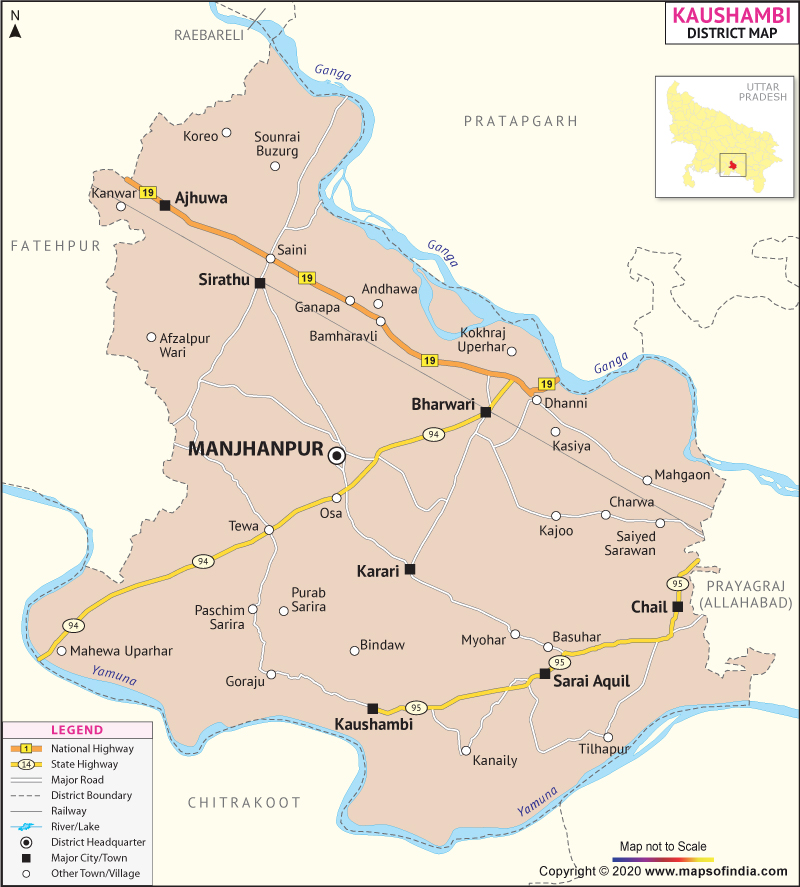
Kaushambi's landscape resembles the other regions of the central Gangetic plains. It is in southern Uttar Pradesh alongside the famous Yamuna River. Most of the land is flat and fertile. Large stretches of fields grow wheat, rice, pulses, and mustard. Soil is located 10% above the alluvial surface, and is formed by the 10% of migrated sourced by the river. The district is also river based and will all be sky brown covered in farming. The district at the end of monsoon will be covered in green. All fish and some other animals spawn and breed in the lakes, which also makes them fertile.
It is common to see different uses for rural ponds, like washing, watering, animals, and even catching fish. This zone represents a climate typical of the north Indian plains. The district is adjacent to Prayagraj and Fatehpur. Resting on the fertile plains, it is also close to major rivers which have determined the geography and livelihood of the inhabitants. The region is simple and rural, characterized by agriculture and close to nature.
| Facts of Kaushambi District | |
|---|---|
| State | Uttar Pradesh |
| District | Kaushambi |
| Location | South-east Uttar Pradesh |
| District HQ | Manjhanpur |
| Population (2011) | 1599596 |
| Growth | 23.70% |
| Sex Ratio | 908 |
| Literacy | 61.28 |
| Area (km2) | 1903.17 |
| Density (/km2) | 897 |
| Tehsils | Chail, Manjhanpur, Sirathu |
| Lok Sabha Constituencies | Kaushambi |
| Assembly Constituencies | 3-Chail, Manjhanpur, Sirathu |
| Languages | Hindi, Urdu |
| Rivers | Yamuna, Ganga |
| Lat-Long | 25.502785,81.429863 |
| Travel Destinations | Ashokan Pillars, Dighambar Jain Temple, Parikshit Fort, Ashram Of Saint Malookdas, Chhetrapal Bhairav Temple, Sheetla Temple, The Jain Temple, Chhetrapal Bhairav Temple, Hanuman Temple Kaleshwar Mahadev Temple, Durga Devi Temple, Sri Ram Temple, Kamasin Devi Temple etc. |
| Government Colleges/Universities | Kaushambi Degree College etc. |
FAQs
Q1: What is the historical significance of Kaushambi?
The region is known for its ancient history. It was the capital of the ancient Vatsa kingdom during the time of the Mahajanapadas. The archaeological remains suggest the region was a center for trade, politics, and religion for several centuries.
Q2: What is the primary occupation of people?
Farming and related activities are the main sources of livelihood for the people of the district. Wheat, rice, pulses, and mustard are the major crops grown in the fields.
Q3: What are the different languages spoken in Kaushambi?
Hindi is the most spoken language in the district. In addition to Hindi, the villagers and market people also use the local dialects, especially Awadhi.
Last Updated on : May 08, 2026
