




Introduction
Ghazipur has an identity built around culture, history, and geography as a combination of different elements and would be considered a distinct place. It has been a known as a place with Rich agrarian and religious heritage, with its location central to the rich plains of the Ganges. The district, which is a part of the Varanasi division, borders the state of Bihar and is thus a location of cultural confluence. The Ganges, Gomti and Karmanasa rivers not only provide irrigation and alter the agrarian and rural economy, they also form a part of the landscape and define the rhythm of the rural economy. It has been a center of learning since historic times with connections to Vedic, Buddhist and later Islamic and then Mughal periods.
The site of Lord Cornwallis's tomb is a colonial remnant of the district. The district has a rich linguistic landscape as Hindi, Urdu and Bhojpuri are the dominant and most widely spoken languages. The district district also has a lively celebration of coexisting cultures with Holi, Diwali, Eid, and Muharram festivals. It has both preservation of traditions and evolution. While the villages retain age-old customs, modernity through rail and road HIGH ways is also seen in the district as it brings modern marketing and commerce.
History
For centuries, the history of Ghazipur district has intertwined, It has a rich history of spirituality, politics and cultural syncretism. In early history, the region was forested and used by sages as a place of retreat. The association with the Vedic traditions earned it the reputation of sacred land. In the district, Buddhism flourished and especially Aurihar, which was a teaching center as evidenced by the remaining stupas and relics.
The Chinese traveler Hiuen Tsang, who visited in the 7th Century AD, described the region as Chanchu which means land of battlefields indicating that the region was both tumultuous as well as having a vibrant history. In the following centuries, the region was governed by several medieval empires. During the rule of the Delhi Sultanate, the region was renamed from Gadhipur to Ghazipur, allegedly in remembrance of Ghazi Malik. Due to the fertile plains that are located along the Ganga, the area was of great significance for trade and agriculture as well as located near Varanasi and the eastern trade centers. The region was a great contributor to the empire's agrarian and cultural network while under the rule of the Mughals.
The colonial period introduced several changes in the country. The district gained prominence as the final resting place of Lord Cornwallis, the Governor General of India; His tomb is an irrefutable landmark of the British colonial presence. The district was officially formed in 1879, as a consolidation of its administrative identity in British India. Agriculture was still the primary economic activity, however, the British i.e. colonial policies influenced the structure of landholding and the trade of agriculture.
Due to the presence of a large-scale opium manufacturing unit in the district (said to be one of the largest in Asia), the British trade networks transformed the district's economy by adding an industrial layer to what was primarily an agrarian economy.
The resilient and unchanging nature of Ghazipur reflects the continuity. Each epoch has left its mark regarding the Court’s early associations with Vedic sages and Buddhist monks, the Sultanate, the Mughals, and the British. The districts’ fertile plains and cultural diversity have sustained and nourished generations. It is a tribute to its history and a nod to its future.
It is a living tribute to the cultural and historical diversity of the entire region. The districts’ history is a record of the influence of various regions over the centuries, but is also a tribute to the unyielding spirit of a region that has stood the test of time and transformed itself.
Culture
Rooted in farming ways, Ghazipur's culture grows from land shaped by the Ganga’s flow. Along those banks, generations live within patterns set by sowing and harvest times. Spiritual practice threads through ordinary days, quietly present in routine acts. Shared history binds different groups who have lived side by side for ages. Seasons unfold with ceremonies that mark changes in soil and sky alike. In village centers, open spaces host conversations passed under banyan shade. Gatherings there form webs of trust, built slowly through spoken words at dusk. Rhythms of labor echo in songs hummed during evening rest.
What one speaks often shapes who one becomes. Though Hindi holds widest use, Urdu along with Bhojpuri carries matching weight, evidence of where this area connects two larger regions. From such a mix, stories have grown through time - poets emerged here whose words shaped both Hindi and Urdu works. Songs passed by voice include wedding verses, lyrical poems, and regional tales sung at festivals or when crops are gathered. These moments guard ways that might otherwise fade.
Alongside dances and small plays at local festivals, such arts unfold stories drawn from ancient tales including the Ramayana and Mahabharata. Where people gather, song appears - devotional chants, regional tunes - the kind that shapes shared moments without need for explanation. Expression moves through thread, rhythm, earth, each form holding its place beyond cities.
What stands out most is how Ghazipur holds together many tongues, beliefs, crafts, along with farming ways. Shaped by endurance, shared life, and ties to soil and stream, its people live within rhythms long established. Rather than merely being a region on a map, it becomes a place where custom and daily routine merge; past patterns still guide what happens now.
Language
Ghazipur district's mix of languages tells a story shaped by past movements, nearby regions, and varied traditions. Located in eastern Uttar Pradesh near Bihar, the area has long hosted speech patterns from multiple directions - this blending built layers into everyday talk. Most residents speak Hindi - it runs schools, offices, paperwork, public notices. Over years, this tongue stitched communities together, whether small hamlets or larger market centers. Yet what flows out of mouths here isn’t textbook Hindi; instead, words twist with Bhojpuri rhythms, adding texture, grounding phrases in village courtyards and farm fields.
Urdu shares significance with Hindi in shaping the region’s linguistic character. Home to poets and thinkers across generations, it contributed deeply to Urdu expression - especially within poetic forms like ghazals and devotional music such as qawwali. Spoken widely in households, bazaars, and community events, it remains alive through groups valuing its grace and rhythm. Where one uses Hindi, another may choose Urdu, shifting naturally based on setting or listener. Such movement between tongues reveals a deeper pattern: centuries of blending traditions quietly embedded in daily speech.
What stands out too is Bhojpuri, rooted deeply in land and feeling. Though often heard in villages, its presence grows strong through folk tunes, sayings, and stories passed by word of mouth. From sowing seeds to festival drums, its expressions echo daily labor and seasonal joy. During marriages, crop gatherings, or village markets, voices rise in song, preserving memory without written trace. Because it stirs shared emotion, this tongue does more than communicate - across time, it holds a community close.
Beyond those three tongues, Ghazipur holds more within its soundscape. Scattered areas murmur with Awadhi and Magahi, shaped by closeness to neighboring regions. Even when spoken less often, they weave into the layered speech environment found here. Because many languages meet, stories told, songs sung, even daily talk have shifted - forming a way of expression rooted deeply in place.
Geography
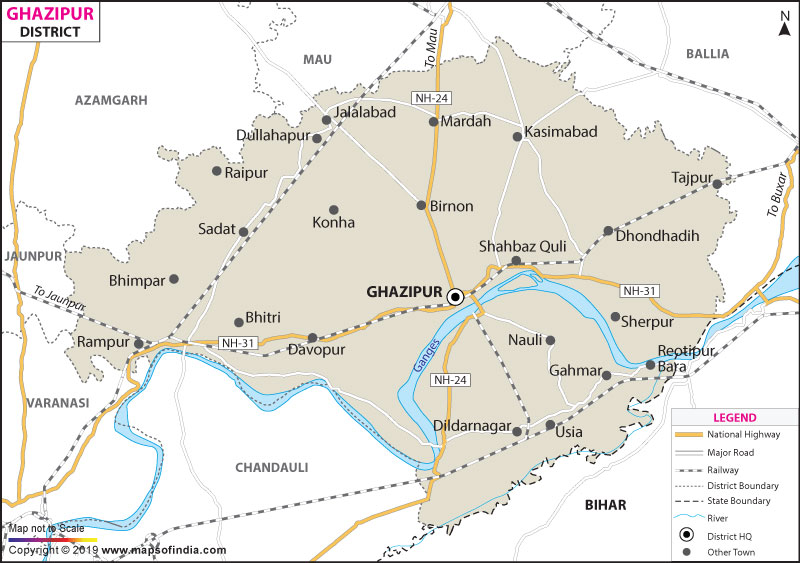
Ghazipur district's agrarian economy is complemented by the fertile Eastern Uttar Pradesh plain, the rivers and the great accessibility to the state of Bihar and to the districts of Varanasi, Ballia and Mau. In its 3,377 square kilometers, all of the land is flat and is dominated by the alluvial soil of the Ganga, Gomti and Karmanasa rivers, with their rich and diverse soil supporting vegetation and agriculture. These rivers also support settlement and cultural life. The subtropical climate and the summer monsoon rains followed by a cool winter also make for good vegetation. The geography of the district is what makes the agrarian economy of the district.
The Ganga is the lifeline of the region, which flows along the edge of the district and the alluvial soils which the river carries and deposits, further enhance the existing soil. Alongside the Ganga, the Gomti and Karmanasa rivers further enrich the soil. This is important for agriculture and the settlement patterns of the region. The rivers provide irrigation for agricultural lands and cultural and social patterns have also been influenced by these rivers, as they are the location of numerous social festivals and cultural rituals. The terrain of the region is mostly flat and is characterized by a high agricultural productivity which is the result of the cultivation of wheat, rice, pulses, and sugarcane. Ghazipur has a subtropical climate which is characterized by hot summers, a dry Monsoonal season (less rain) that has the most of the annual rain falls, and cool winter which is characterized by the dry season that is favorable for the cultivation of rabi crops. With national highways and railways, Ghazipur has been able to better weave itself into the regional trade networks, and the agrarian economy is still sustained by its geography. Essentially, the geography is alive, the rivers, the plains, the climate, they all sustain life and create traditions, making the district an active entity in the eastern part of Uttar Pradesh.
| Facts of Ghazipur District | |
|---|---|
| State | Uttar Pradesh |
| District | Ghazipur |
| District HQ | Ghazipur |
| Population (2011) | 3620268 |
| Growth | 19.18% |
| Sex Ratio | 952 |
| Literacy | 71.78 |
| Area (km2) | 3377 |
| Density (/km2) | 1072 |
| Tehsils | Ghazipur, Jakhania, Mohammadabad, Saidpur, Zamania |
| Lok Sabha Constituencies | Ghazipur |
| Assembly Constituencies | Ghazipur, Jakhanian, Jangipur, Mohammadabad, Saidpur, Zahoorabad, Zamania |
| Languages | Hindi including Bhojpuri |
| Rivers | Ganga |
| Lat-Long | 25.621716,83.522758 |
| Travel Destinations | Cornwallis Mounment, Aunrihar, Bahadurganj, Bhitari, Dildarnagar, Zamania etc. |
| Government Colleges/Universities | Post Graduate College, Ravindrapuri, Swami Sahajanand P G College, Khardeeha Degree College, Shahid Smarak Govt. Degree College, Skbm Degree College, Shree Prabhu Narayan Singh Degree College, Rajkiya Degree College, Rajkiya Mahila Degree College, Samata Degree College, Hindu Degree College etc. |
FAQs
Q1: What is the historical significance of the district?
The district is historically important because of the Vedic sages, the Buddhist learning centres, and the Mughal and colonial periods. It is also famous for the tomb of Cornwallis, the British Governor-General who died in 1805.
Q2: Which languages are commonly spoken here?
The predominating language is Hindi, but other languages such as Urdu and Bhojpuri are also spoken. This adds to the literary culture of the district.
Q3: What are the main rivers in the region?
The main rivers are Ganga, Gomti and Karmanasa. All these rivers pass through Ghazipur and contribute to the fertility of the plains and the economy of the people. They also play a significant role in the culture and festivals of the region.
Last Updated on : May 08, 2026
