




Introduction
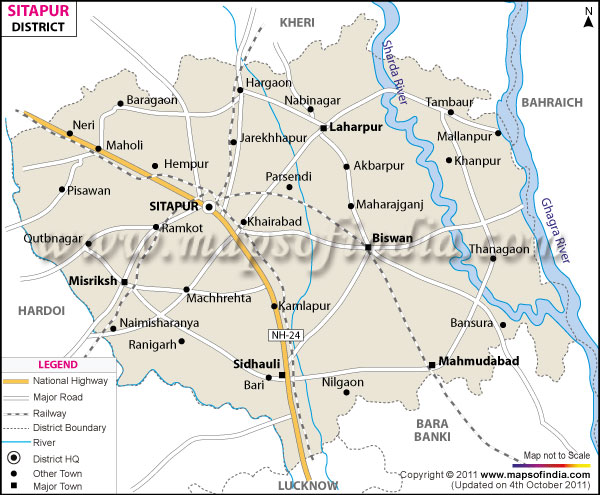
The district headquarters located in the town of Sitapur where it serves as the centre of trade, governance, education and healthcare to the rural ones.Sitapur lies to the north of the state capital Lucknow, clearly visible on the sitapur district map, and is part of the extensive geography of the alluvial plains which dominate the geography of much of northern India and its agricultural potential.
The country is mostly rural and the villages are scattered throughout the fertile farmland which is supported by the river systems and the monsoon rainfall. Agriculture is the major occupation and a large percentage of the population is actively involved in farming, keeping livestock and other related activities in the rural areas.
A Sitapur district is administratively subdivided into several tehsils and development blocks, which also help in governing and administering the rural areas. The district has road and rail connectivity with Lucknow and the surrounding districts and therefore its integration with the rest of the economic system in the state. Although the development and infrastructural expansion is slow, Sitapur remains predominantly agrarian and conservative in nature where the social aspect of life still centers around village groups, religious practices and the seasons.
History
The Sitapur district history represents the stratified history of the northern India. The area was a part of the old cultural domain of Kosala kingdom, which is often referred to in the ancient Hindu texts and epics. It lies close to major religious hubs in the heart of Uttar Pradesh and therefore lies in the sacred geography of the early Indian civilisation. Throughout the centuries, the region has experienced the emergence and demise of several political forces that influenced its administration and culture.
In the early medieval days, the region was incorporated into bigger North Indian polities. The region came under the control of Islamic rule with the formation of the Delhi Sultanate in the thirteenth century thus introducing new administrative systems and cultural influence in the region. The old traditions were not forgotten with this change but in fact led to a slow cultural synthesis that can be observed today in the linguistic and religious diversity of the district.
Sitapur became a part of the Mughal Empire Awadh province which later grew to be a semi-autonomous state under the Nawabs of Awadh. The Awadhi culture with its unique etiquette, cuisine and language style affected the social life of Sitapur. It is a mixture of Hindu and Islamic traditions in the form of architectural remains, religious edifices, and local traditions.
Awadh was annexed to the British East India Company in 1856 and Sitapur came under direct colonial rule. In the next year, in the Indian Rebellion of 1857, the area was involved in unrest as an extension of the uprising in the rest of northern India. This uprising was a great turning point and the Company rule was dissolved and the direct rule of the British Crown was instituted. Sitapur, as with a lot of the Awadh, had been reorganised under British administration in terms of administration, reforming of revenue and development of infrastructure.
Gradually the railway and road systems advanced the connectivity, which in turn did not stop the economy of the district being based mostly on agriculture. Sitapur is in the state of Uttar Pradesh in the Republic of India, after India gained its independence in 1947. Land reforms which took place after independence, increased education and rural development programmes were some of the factors which led to slow social and economic transformation. However, the social structures and village life has been so strong in the identity of the district.
Culture
The cultural legacy of the Sitapur district is full of the larger and more traditional traditions of the central Uttar Pradesh region, clearly visible on the sitapur district map, which have been infused with centuries of history of interaction and continuity in the countryside. The agrarian life is strictly connected with social one, and sowing and harvesting are the main events of year which impact community celebrations and rituals significantly. Festivals are also a time of both religious piety and social unity and belonging.
Hindu festivals like Diwali, Holi, Dussehra, Navratri are observed throughout the district that is usually accompanied by fairs and local markets. The surrounding villages have strengthened their bond as these events meet the residents of those villages. The Muslim community also celebrates Eid and other Islamic festivals with equal zeal which indicates that there is a common cultural space in the district. The interreligion has created the tradition of respect towards one another and inclusion in the festivals of the other.
An ancient pilgrimage centre called Naimisharanya that has been worshiped by the Hindu culture is one of the most significant cultural-religious locations on the district territory. It is believed to be a sacred site that is mentioned in a number of puranic texts and was believed to be a place where sages gathered and recited religious texts. Naimisharanya is also a place of significant religious significance in Uttar Pradesh with Pilgrims visiting the Naimisharanya all year round, especially during momentous times.
Villages of Sitapur are still endowed with folk traditions. Social and religious ceremonies are incomplete without oral storytelling, devotional singing on Awadhi dialect, and also traditional wedding songs. This movement of musical expression commonly depends on rudimentary instruments including the dholak and harmonium, and concerts are usually not commercial. Such art forms are keeping the language subtleties and area history between generations.
Sitapur cuisine resembles the wider cuisine in the Awadh region however in the simple rural fashion. Wheat chapati, rice, lentils and vegetables in seasons are considered to be the staple foods. Dairy products and milk are typical because of livestock farming, whereas feasts can include more luxurious cuisine, which may be affected by Awadhi cuisine. Food is not only a supplement of life but also a gesture of hospitality and social bond.
Sitapur, clearly visible on the sitapur district map has extended family structures and kinship ties and community networks have a high level of emphasis. Dispute resolution and collective decision-making are still affected by the village councils and informal social mechanisms. Even though contemporary education and urbanization are slowly changing the aspiration, issues that make the traditional society like obedience to the aged and social responsibility take the center stage in the day to day living.
Language
Hindi is the major and official language in Sitapur district and is applied in administration and education as well as formal communication. In addition to the standard Hindi, Awadhi is a popular language which is used in the day-to-day conversation particularly in the rural setting. Awadhi has a great literary tradition and is an important element of local identity. The Urdu is also used among some of the members of the population and especially among the Muslim communities, and this is an indication of the historical impact of the composite culture of Awadh.
Geography
Sitapur is geographically located in the fertile plains of the middle Ganga basin, clearly visible on the sitapur district map. It is a relatively flat country with large agricultural lands in between villages and small market towns. This is because the alluvial soil that has been deposited by river systems over the centuries renders the district very favorable to cultivation. This fertility is found in nature and supplies the agrarian economy of the district and a high population density.
The district is irrigated by several rivers and tributaries which also determine the way people settle in the region. These waters are also of great value to the agricultural industry during rainless months when irrigation is being done to complement the rainfall brought by the monsoon winds. However, seasonal flooding can be difficult to manage especially during floods in certain parts of the low-lying areas, hence affecting crops and infrastructures.
The climate of sitapur is humid sub tropical. Summers are hot and dry and the temperatures tend to reach more than 40 centigrade during the months of May and June. The monsoon begins at the end of June and extends to September and is the main contributor of the rainfall in a year. This is a seasonal pattern that regulates agricultural patterns whereby wheat is grown during winter and rice in monsoon.
The vegetation in the district to-day is mainly cultivated crops with few groves of trees. The region as was known was historically nearer to the forested tracts that were linked to the Terai belt but agricultural encroachment has converted most of the land into a farmland. However, the fields and village commons are still lined with trees which offers ecological balance and shade.
Sitapur is linked to Lucknow and other neighbouring districts via highways and railway lines via transport infrastructure, clearly visible on the sitapur district map. These links provide trade, education/medical care access, and transportation of agricultural produce to bigger markets. Urban development has not yet become very intensive as compared to big cities, but the better connection has already made the economic prospects more favorable without any profound change in rural nature of the district.
| Facts of Sitapur District | |
|---|---|
| State | Uttar Pradesh |
| District | Sitapur |
| District HQ | Sitapur |
| Population (2011) | 4483992 |
| Growth | 23.88% |
| Sex Ratio | 888 |
| Literacy | 61.12 |
| Area (km2) | 5743 |
| Density (/km2) | 779 |
| Tehsils | Biswan, Laharpur, Mahmudabad, Misrikh, Sidhauli, Sitapur |
| Lok Sabha Constituencies | Sitapur, Misrikh, Dhaurahra, Mohanlalganj |
| Assembly Constituencies | Biswan, Hargaon, Laharpur, Mahmoodabad, Maholi, Misrikh, Sevata, Sidhauli, Sitapur |
| Languages | Hindi, Awadhi, Urdu |
| Religion | Predominantly Hindu |
| Rivers | Ghaghara, Sarda |
| Lat-Long | 27.542371,80.897026 |
| Travel Destinations | Namisharanya, Chakratirth, Lalita Devi Temple, Panch Prayag, Vyas Gaddi, Soot Gaddi, Sri Hanuman Garhi, Panch Pandav, Mishrit, Shyamnathan Temple, Suraj Kund Temple, Cheeta Pasi Ka Tila, Gandhi Park, Nehru Park, Ilasiya Bal Vanodyan etc. |
| Government Colleges/Universities | Pandit Deen Dayal U. Govt. P. G College, Govt. Fakerudeen Ali Ahemed Degree College, Acharya Narendra Dev T. T. College, Dayal Degree College, H. K. M. P. G. College, H. M. H. Digree College, Hajari Lal Degree College etc. |
FAQs
Q1: What is the administrative division of Sitapur district?
Lucknow division of Uttar Pradesh includes Sitapur district, clearly visible on the sitapur district map.
Q2: What pilgrimage place in Sitapur does the Hindu scripture speak of?
The place of Naimisharanya in Sitapur is covered in a few Puranic sources as a forest belonging to sages.
Q3: What is the major line of activity of the people of Sitapur district?
The majority of residents of the Sitapur district have to work at agriculture and other economic activities of the countryside.
Q4: What is the climatic pattern affecting the agriculture of Sitapur district?
The humid subtropical climate that is characterized by the presence of monsoon rains greatly influences the time when crops are planted and harvested.
Last Updated on : May 08, 2026
