




Introduction
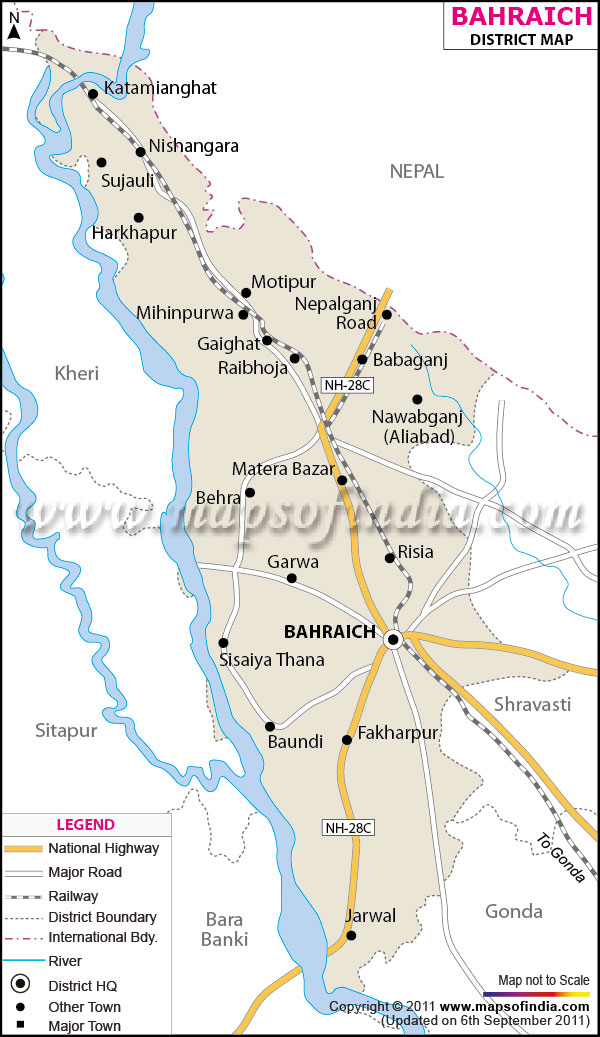
Bahraich is a key district in Uttar Pradesh, India. It is in the north eastern part of the state and also has a border with Nepal. Because of this location, Bahraich has a culture which is a mix of that of India and Nepal. Bahraich district is home to many villages, farms and markets and also a host of religious places. Agriculture is very much a part of the people’s life in Bahraich. Also the district is a tourist spot which is also famous for its religious sites and natural beauty.
History
The history of Bahraich is a very ancient and spiritual story which we trace back to the birth of the universe. In local myths this land is home to Lord Brahma, the creator of all that is. It is said he picked out this wonderful, forested area for great sages and wise men to use for meditation. That is the reason many people put forth the theory that the name “Bahraich” comes from “Brahmarchi” which means the place of Brahma’s sages.
In the olden days the district was a part of great Kosala kingdom. From our historical records it is known that King Luv, son of Lord Rama, ruled over this area from is capital at Shravasti. Also it is believed the Pandavas from the Mahabharata visited these dense forests during their exile. The city has through the ages been a place which saw meeting of different religious paths from the early Vedic rishis to Buddhist monks who lived here thousands of years ago.
In the Medieval past of Bahraich the Great Battle of 1033 is what is known today. At that time a powerful local king which was Maharaja Suheldev led a group of chiefs in a fight to protect their land from the invader Salar Masud. The battle took place at the edge of Chittaura Lake, also it is today that Suheldev is remembered as a hero which stood up with great bravery for the defense of the culture and freedom of the region.
As the years went by the district fell into the control of the Delhi Sultanate and later the Mughal Empire. At the time of Emperor Akbar’s rule Bahraich was one of the five main parts which made up the Awadh province. The city grew to be a center for learning and Sufi practices. It was in this time that the Dargah of Sharif Sayyad Salar Masud Ghazi was built which we still see today and which is a site where people of all faiths come together to pray.
In the 19th century the history of Bahraich saw another struggle as the British East India Company took over Awadh. Local Rajas and the common people were a part of the 1857 freedom fight. Many valiant soldiers from Bahraich gave their lives fighting the colonial army at river banks. After Independence in 1947 the district began to develop as a farming and natural tourism destination also following the establishment of the Katarniaghat Wildlife Sanctuary.
Today we see the district as a bridge which spans the past and the present. Out of which grew a community of farmers that for generations have worked the same rich soil the kings of past ages protected. From the ancient temples of Lord Brahma to the modern schools and forest reserves what we have is a story of peace, strength and also of very deep rooted faith in nature.
Culture
The culture of Bahraich is a fine example of coexistence of various religions and traditions. As a town that straddles the border of India and Nepal, the way of life is very open and welcoming. Here people are very much rooted to their past which you see in their day to day doings, in the polite way they speak, and in the way they come together to celebrate festivals.
At the core of what it means to live in this area is a very strong faith. We see in Dargah of Salar Masud Ghazi a primary example of that which brings together people of different faiths Hindus and Muslims pray there. Also each year we have a large fair or “Mela” which takes place which sees the streets filled with music and fair grounds and which also brings together people from all over the country. This shared tradition is the base of the culture in Bahraich.
In the area that is primarily agricultural like Bahraich, the culture is very much of the land and the seasonal cycles. We see many festivals which are in honor of nature’s bounty. Also you will note that in the evenings village women come together to sing folk songs which they term “Sohar” or “Kajari” in the monsoons. In these songs they talk of their families, love, and the green fields which are a hallmark of the Awadh region.
In culture of Bahraich food plays a very important role. It is simple in style yet very flavorful which has the influence of the well known Awadhi style of cooking. People here love fresh rotis, spicy vegetable curries, and rice they grow in their own fields. In the local markets also you must try the traditional sweets like “Peda” and “Imarti” which are made from the village dairy farms’ fresh milk.
Art and craft is a large part of what we see in many of these communities. In many homes you will find that members are into wood and bamboo work which is very abundant in the nearby forests. Also it is in the local markets you will note that hand made clay pots and copper vessels do very well. What we see is that these crafts are more than just a past time they are in fact skills which have been handed down through the generations and which in turn keep the local economy alive.
Here what we see is a very simple and traditional way of life. People here prefer the peace of the countryside to that of large cities. They have a great respect for their elders and also a very strong community feel. At a wedding or at a small village get together the culture of Bahraich comes out in the sharing of food, music, and joy.
Language
The language of Bahraich is a blend of what is present which also tells the story of the district’s past. It is true that Hindi is the main language in the schools and government offices but at home and in the heart of the people there is spoken a dialect of Awadhi. This dialect is known for its soft spoken nature which in turn makes any ordinary conversation very polite and respectful.
In the neighborhood of the Nepal border which is what this district is, its language also has input from nearby languages. In the north of the district by the forests you may hear terms which are in the Nepali or Tharu languages. This mix of cultures has put forth a very unique local vocabulary which you won’t see in the big cities like Delhi or Mumbai.
Urdu also plays a very large role in our linguistic environment. Due to the famous Sufi shrines and what was in the past the City’s connection to the Nawabs of Awadh we see many of the population use very beautiful Urdu words in their every day speech. Also very often at small get togethers you will hear local poets recite “Shayari” which is a mix of Hindi and Urdu that they use to put forth their feelings in a very graceful way.
Geography
Bahraich has a very distinct geography as it is located in the “Tarai” belt which is at the foot of the Himalayan ranges. This area is very low lying which in turn makes the land very moist and full of life. Also it borders Nepal to the North which in turn makes this district a key point for trade and travel between the two countries.
Water is a large element of the geography in Bahraich. This district sees the flow of the Ghaghra, Saryu, and Rapti which I think of as giant silver bands. These rivers are what the local farmers live by which see report as the lifeblood of their crop production all year round. That is to say during monsoon season which is the wet season these rivers do indeed get very wide and at times do flood the nearby fields.
Another wonderful element to the scenery is the vast forests. In the case of the Katarniaghat Wildlife Sanctuary which extends into the major part of the north we have a large example. This forest is home to tall Sal trees, swamp like grasslands, and very deep river channels. It serves as a natural passage for animals which travel between the forests of India and the mountains of Nepal.
The climate changes with the seasons. In summer the sun beats down on the flat plains very hot. But with the monsoon’s arrival, the area sees lots of rain which in turn makes the whole landscape a rich dark green. Winters are cool at times and very foggy which in fact works well for certain crops which do better in wet soil.
| Facts of Bahraich District | |
|---|---|
| State | Uttar Pradesh |
| District | Bahraich |
| District HQ | Bahraich |
| Population (2011) | 3487731 |
| Growth | 46.48% |
| Sex Ratio | 892 |
| Literacy | 49.36 |
| Area (km2) | 5745 |
| Density (/km2) | 415 |
| Tehsils | Bahraich, Kaiserganj, Mahasi, Nanpara |
| Lok Sabha Constituencies | Bahraich, Kaiserganj |
| Assembly Constituencies | Bahraich, Balha, Kaiserganj, Mahasi, Matera, Nanpara, Payagpur |
| Languages | Hindi, Urdu, Awadhi |
| Currency | Indian Rupee (INR) |
| Religion | Mostly Hinduism and Islam |
| Rivers | Ghaghara |
| Lat-Long | 27.751608,81.429863 |
| Travel Destinations | Dargah Sharief, Chittaura Jheel, Temple Of Junglee Nath, Kailashpuri Barrage, Kartaniya Ghat Alligator Breeding Center etc. |
| Government Colleges/Universities | St. Peter Inter College etc. |
FAQs
Q1: Why do we call Bahraich a Border District?
Bahraich which is in the north has a large international border with Nepal. This makes it a key gateway for trade and cultural exchange between the two countries which pass through the Rupaidiha border crossing.
Q2: Which large rivers pass through the district?
The district is home to a number of large rivers which include the Ghaghra, Saryu and Rapti. These rivers which play a key role in the district’s very large agriculture sector also help to maintain the fertility of the soil.
Q3: What do people in Bahraich do for a living?
In most of the population agriculture is the base. In the fertile Tarai area which we are in farmers produce large amounts of rice, wheat, maize and sugarcane all year round.
Last Updated on : May 08, 2026
