

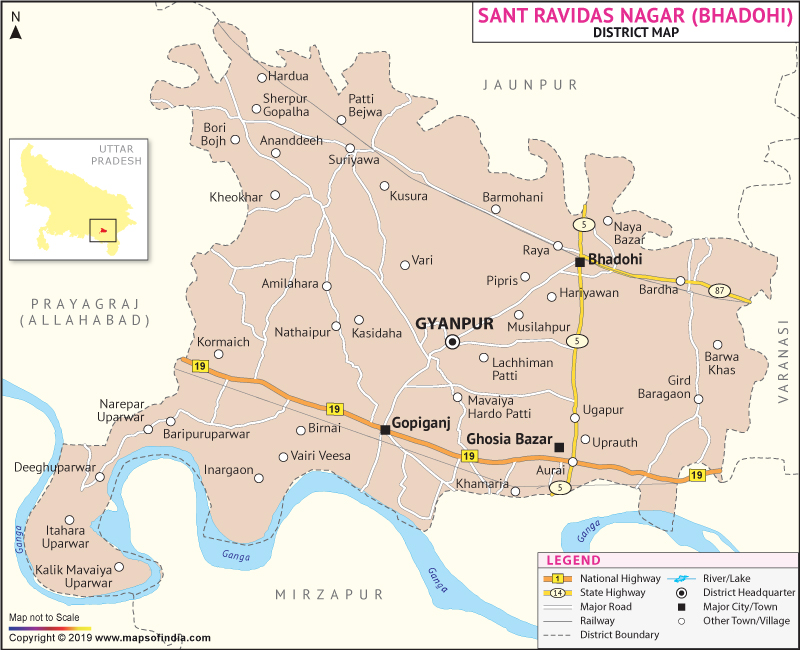





About
Sant Ravidas Nagar is a district in eastern Uttar Pradesh, India. A majority of the population still refer to the district in its older name of Bhadohi, derived from the name of the city, Bhadohi. The original derivation of the name "Bhadohi", with its reference to Bhadoh, the name of a savage, is not only pre-Islamic in character, it is also non-indic in origin, which looking at it from the study of such local nomenclatures is noteworthy. The name appears on government records and sign-boards, but "Bhadohi" continues to be used in the money transfer chains and in trade circles, and even in casual discourse, even to this day. Jaunpur district is situated in the Mirzapur division in the Gangetic plain of eastern Uttar Pradesh. Jaunpur situated between two of the oldest cities of India and of Uttar Pradesh-Varanasi in the east and Prayagraj in the west, the district is bounded on the north by Jaunpur, and the south by Mirzapur. The Ganges flows by the southern boundary of the district. It has 960 sq. Km. The smallest district of Uttar Pradesh in size.
Key Highlights
Bhadohi is renowned for hand knotted carpets with 'Geographical Indication' tag. Bhadohi has the first-ever & India's only Indian Institute of Carpet Technology set up in the district to train designers, technicians, and managers for the carpet industry. Apart from carpets, Bhadohi is linked to the holy place Sitamarhi situated on the river Ganga bank, with the saint Sant Ravidas and culturally rich folk music and festival traditions. Though one of the smallest districts, Bhadohi is one of the most densely populated districts of the state.
History & Culture
Early and Medieval Roots
The area is located in the old cultural zone of Kashi and neighbours, where settlements by the Ganga track for thousands of years. It is chronicled in local tradition that the appellation 'Bhadohi' is related to the Bhar community, who occupied and inhabited certain regions of eastern Uttar Pradesh in medieval times, and a commonly accepted explanation is that the name refers an origin from a Bhar settlement. The problem is still under discussion by historians but it is quite certain that the Bhrs settled in this belt area. This district is home to the craft that the Mughals have most associated it with. Legend has it that Persian weavers, who had travelled with the Mughal emperors, had made this region of the Gangetic plain their home and that they had imparted their craft of hand-knotted carpet weaving to the local populace. If that is true, the craft took hold here a few centuries ago, from masters to students to their children.
Banaras Estate and the Colonial Period
It was under the rule of the British penetration of the region was in the domain of the Kashi (Benaras) rulers. Bhadohi was come under the first Maharaja of Banaras princely state had recently established it in 1911. Much of this region continued to have an economy traditionally rural with carpet weaving establishing itself as a village based trade. Colonial trading corridors made an outlet for exports and carpets produced in the area reached European and American markets. Next, demands for proper administration in the populated region led to the establishment of a separate district in 1994. The district has since established its own offices, courts, and colleges, health facilities and is also well known for its carpet trading.
Cultural Heritage and Traditions
Sant Ravidas Nagar is essentially a Bhojpuri and Banarasi culture. The language of common speech, both oral and ceremonial, resembles that of Varanasi and the entire region of Purvanchal. The social perspective of district is all influenced by reverence of Sant Ravidas. He is eulogized in public meetings in his temples and shrines by the natives of the district and his compositions on equality and labour well-liked by the community.
Economy
Overview of the Economic Structure
Sant Ravidas Nagar economy is not as diverse. The district has few large industries, so about 70 per cent of the population is involved in the agricultural sector. Yet, sant Ravidas Nagar also has an industrial persona through the carpet industry, which is proportional to its size. Large sections of the community are indirectly or directly engaged in textile manufacture that builds in a series of activities that range from, its main component of spinning and dying, to designing finishing washing and exporting.
The Carpet Industry
Carpet sector is the most important economic base of the district. Carpet of all three tehsils are knotted, tufted, and woven in homes, small, and large scale factories. Carpets are woven using different materials including wool, silk, cotton, and various blends. Designs and motifs reflect both traditional Persian golden mirror and modern geometric motifs. Carpet exporters of Bhadohi export their products to the United States, Europe and Middle East and others. It is one of the highest producing carpet district of India. Much of the weaving is done inside the rural homes, because of this providing a steady incomes for women and handloom artisans from small farming households. The Carpet Expo Mart in Bhadohi offers an opportunity for exporters and visiting buyers to display and examine goods. The Indian Institute of Carpet Technology (IICT) trains young people in design and production, thereby ensuring that the trade can replace the gradually retiring weavers with fully trained new workers.
Government Sector
The government is a reliable provider of jobs and funds. The district administration police revenue offices courts schools and colleges and health centres are all large employers. Block offices, panchayats, and municipal councils are responsible for things like roads, drainage, and water supply. Welfare schemes, rural work programmes and housing are then further injection of money into villages.
Public Sector
The public sector institutions in the district include nationalised and co-operative banks, post offices, power, and distribution offices, railway institutions and highway agencies. Banking branches cater to the credit requirements of farmers and also enable small weaving units to access loans. Electricity and road links are maintained by public organizations and are valuable to workshop owners for their smooth supply and transport facilities.
Services Sector
Trade and services are expanding in the towns of the district. In Bhadohi, Gyanpur, Gopiganj, and Aurai, there are markets for cloth grain hardware, and everyday commodities. A significant group of employment consists of transport carriers, truck owners, crew, and freight agents, warehouse proprietors, owners of hotels and guest houses, private managed institutions, coaching places clinics the small eating places.
Tourism
Sitamarhi (Sita Samahit Sthal)
The most famous pilgrim site in the district is Sitamarhi located in the Gyanpur area on the Ganga; per belief, it is the place where Sita descended into the earth. Sitamarhi is also identified with the Valmiki tradition. Pilgrims come to the site's temples, bathe in the sacred pond, or bathe in the river; there is a very tall image of Hanuman at this site, which is visible from some distance. Fair and Mela are organised here on important festival days. On the day of Kartik Purnima, here is a relatively large turnout of pilgrims.
Ganga Ghats and Riverbanks
NORTH BANK of ghat of northern bank of ghat of the Ganga the Ganga Quiet ghats on the of lonely ghats of the Ganga the Ganga in the a village of mostly the hectic ghats of ghat of ghats of ghats of the tourists.
Carpet Workshops and Weaving Villages
The most unusual revelation of the district for visitors with a passion for handcrafts is a visit to one of the weaving clusters. In this textile hub, one can watches knots being tied continuously into a pattern, observe dried coloured wool in the sunlight and mingle with weaving families that have inherited the craft. Most exporters open their showrooms to serious visitors, and prospective buyers by appointment via the chamber of commerce or local guides.
Old Town Markets and Historic Structures
Busy markets, old havelis and tiny temples in the historic parts of Bhadohi, Gyanpur, and Gopiganj highlight the district's storied trading tradition.
Nearby Destinations
Located between Varanasi and Prayagraj, tourists can couple their stay with the temples and ghats of Kashi Sarnath the Sangam of Prayagraj, and the temples of the Vindhyachal across the Ganga in Mirzapur. Well-connected by rail, road, and highway, it makes for an easy day's trip.
Demographics
Population
The 2011 Census found that there were 1,578,213 people in the district, with 807,099 men and 771,114 women, which makes the sex ratio of approximately 955 women per 1,000 men. Of these inhabitants 1,348, 911 lived in the rural areas and 229,302 in urban areas; so nearly 85 percent of the population lives in villages.
Literacy Rate
The 2011 literacy rate was 68.97 percent; male literacy 81.47 percent, female literacy 56.03 percent. The gap is fairly wide and most local programmes are concentrated on girls' schooling and adult literacy. Carpet weaving had dragged many children into employment in previous decades and the law against child labour has been tightened. Bhadohi and Gyanpur colleges and polytechnic institutes are providing higher education close to home.
Languages Spoken
Official language is Hindi with 97.76% of the population following it in daily lives and lifestyle. But in every-day life, people are used to speaking in Bhojpuri, the local Dialect of Purvanchal in their homes, markets, and folk tunes. Some of the population communicate in Urdu others speak in English as many of the export trade traders, merchandisers, and designers frequently interact with overseas buyers. Hindus population is 86.7percent with Muslim as the next largest minority.
Administration
Division, Headquarters, and Tehsils
The district comes under the Mirzapur division. The district has its headquarter at Gyanpur and comprises three tehsils of Aurai, Bhadohi, and Gyanpur. Based on census 2011, the population of Bhadohi tehsil is 568985, of Gyanpur tehsil is 567801 and of Aurai tehsil is 441427. Bhadohi town is the most populated and commercially active urban area and the district is administrated from Gyanpur.
Villages and Local Bodies
The district has a total of 1217 villages. There are about 1075 inhabitant villages in the districts on some records and other record giving the number of all villages, inhabited, or uninhabited. Because of this, it varies whether uninhabited villages are to be counted or not. When considering villages, then hierarchy of gram panchayats and nyay panchayats takes over and the rural programmes are looked after through development blocks of Bhadohi Gyanpur Aurai Abholi Deegh Suriyawan.
Towns, Police, and Representation
There are 2 Nagar Palika Parishads, 5 Nagar Panchayats and some census towns in the urban area. There are 9 police stations (Aurai Bhadohi Chauri Durgaganj Gopiganj Koirauna Gyanpur Oonj Suriyawan) in the district. The district has assembly segments (Bhadohi, Gyanpur, and Aurai) and is a part of constituency (Bhadohi) for the Indian Parliament.
| Facts of Sant Ravidas Nagar District | |
|---|---|
| State | Uttar Pradesh |
| District | Sant Ravidas Nagar |
| District HQ | Gyanpur |
| Population (2011) | 1578213 |
| Growth | 16.58% |
| Sex Ratio | 955 |
| Literacy | 68.97 |
| Area (km2) | 960 |
| Density (/km2) | 1531 |
| Tehsils | Aurai, Bhadohi, Gyanpur |
| Lok Sabha Constituencies | Bhadohi |
| Assembly Constituencies | Aurai, Bhadohi, Gyanpur |
| Languages | Hindi, Bhojpuri |
| Rivers | Ganga |
| Lat-Long | 25.319201,82.435513 |
| Travel Destinations | Baba Harihar Nath Temple, Sai Dhaam, Chakwa Mahavir Mandir, Ghopaila Devi Mandir, Gyan Sarovar, Raja Park, Mukherjee Park etc. |
| Government Colleges/Universities | Kashi Naresh Post Graduate Collage (K.N.P.G), Ram Dev P. G. College, Buddhiram Dubey Mahila Mahavidyalaya, Vimal Singh Mahavidyalaya etc. |
FAQs
1. How many villages are there in Sant Ravidas Nagar district?
The district has 1,217 villages according to Census-based district data.
2. What is the population of Sant Ravidas Nagar district?
The 2011 Census recorded 1,578,213 people in the district. This included 807,099 men and 771,114 women.
3. What is Sant Ravidas Nagar famous for?
It is famous for hand-knotted carpets and is often called the Carpet City of India.
4. Why is the district called both Bhadohi and Sant Ravidas Nagar?
Bhadohi is the original name, and Sant Ravidas Nagar was adopted later to honour the saint.
5. Which tehsils make up the district?
The district has three tehsils: Bhadohi, Gyanpur, and Aurai.
6. Where is the district located?
It lies in eastern Uttar Pradesh between Varanasi and Prayagraj, in the Mirzapur division.
Last Updated on : November 12, 2026
