




Introduction
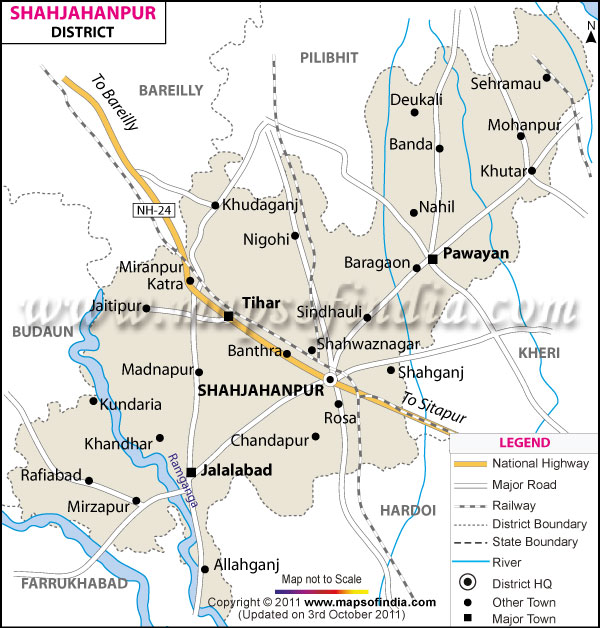
The district of Shahjahanpur is a major administrative and cultural territory of the Indian state of Uttar Pradesh which is located in northern India. It lies in the Rohilkhand division and takes up a key location that borders both the Ganga plains and terai belt in the north. The city of Shahjahanpur is its administrative centre and it also serves as the political, commercial, and educational hub of the region. The district lies in an area which is enriched with history and agricultural significance that have made their contribution so much in the socio-economic fabric of northern India as well.
History
The political change of northern India is heavily connected with the historical development of the Shahjahanpur district. Before the Mughal era, the region was composed of forested tracts and few settlements populated by the local tribes and chiefs. Rajput families had been influential in some of the regions and the agricultural growth was slow and led to the formation of villages on paper.
The town is usually founded during the rule of the then Mughal emperor Shahjahan, in the seventeenth century. It is said that the settlement was acquired by the name of him, the administrative union of the Mughals in the area. During the Mughal rule, the region was incorporated into the imperial administration. Surveying of land, taxation and selection of local officials enhanced government and promoted agriculture. Trade routes between Delhi and Awadh took place through the nearby territories and advanced the trade.
As Mughal power started to wane gradually in the eighteenth century, Rohilla Afghan chiefs also became influential in Rohilkhand. This territory was drawn into a complicated political situation between Rohillas, the Nawabs of Awadh and the British East India Company, who were growing stronger. It is these wars that had transformed the form of administration and had altered the landholding patterns. Eventually the British army conquered Rohillas, and the territory came under colonial power.
The district became a part of the North-Western Provinces under British rule. The revenue settlements like the Mahalwari system and subsequent changes reformulated the land ownership. Zamindars became prominent as peasants had to pay taxes. The 19th century saw the advent of railways, which contributed to improved connectivity, ease of transport of goods such as grain and sugarcane. Colonial governance was also established through the establishment of roads, courts and municipal institutions, solidifying the existence of colonial governance.
The 1857 Revolt made the mark in the territory. Resistance was conducted by local soldiers and civilians against the British power, and the post-result was repression and tightening of the administration. At the beginning of the twentieth century, revolutionary nationalism became related to the district. Ram Prasad Bismil and Ashfaqulla Khan were examples of freedom fighters who had major involvement in the Kakori Conspiracy of the year 1925, which was a landmark in the Indian independence struggle. All this execution by the British made them martyrs and figures of patriotic martyrdom.
The district of Shahjahanpur joined the reorganized state of Uttar Pradesh after gaining its independence in 1947. Land reforms to get rid of zamindari transformed agrarian structures. With the course of time, the district became accustomed to democratic rule, where infrastructure, as well as social facilities extended, and the district had retained the staple of agrarianism.
Culture
Shahjahanpur district has a rich cultural life that is an indication of a composite heritage- which has been shaped by centuries of co-existence among people of different communities. Social spaces, markets and traditions have been longstanding between Hindu and Muslim populations leading to the establishment of a syncretic culture in which they engage in mutual activities involving festivals and ceremonies. There are significant festivals like Diwali, holi, eid-ul-Fitr and Muharram which are celebrated with great enthusiasm and usually the neighbors who are of different religions are also included.
Part of rural and urban life is made up of local fairs, or melas. These gatherings are centered around temples, shrines and seasonal events. They allow one to trade, entertain themselves, and interact socially. These events are brought to life by folk performance, puppet shows, and traditional music that keep the traditions of the oral tradition that are transmitted through the generations.
Music and poetry are respected aspects of the culture of the district. Urdu mushairas and Hindi kavi sammelans are held periodically attracting poets and their audiences around the neighborhood. The literary gathering is the festivity of art language and the concepts of romance and spirituality are discussed together with the issues of patriotism and social reform.
The cuisine has some influences from Awadh and Rohilla. Dishes with a high degree of spices, kebabs, biryani, and traditional breads are popular dishes in urban families, whereas rural families use wheat-based rotis, lentils, seasonal vegetables, and dairy products. Desserts like jalebi and peda are staples of festivals and wedding celebrations. The food traditions, therefore, incorporate the local food products with the cuisine.
The rituals of marriage are very elaborate and it may take a number of days. The traditional wear comprises sarees, lehengas, sherwanis, and kurta-pajamas although new modernized clothes are increasingly becoming part of the wardrobe. Respect to elders, hospitality and close relationships with members of your kinship are all key aspects of social existence.
Cultural identity is also brought about by handicrafts and small industries. Agricultural tools, metallurgy, weaving, and carpentry have been used to maintain the rural life. Despite the introduction of industrialization with its subsequent production mechanization, there are still numerous houses that use the traditional crafts. It is therefore, the daily routine and the celebratory events that preserve cultural continuity.
Language
The linguistic environment of Shahjahanpur district is seen to be diverse and adaptable. The native language of government, schooling and press is Hindi. The Standard Khari Boli Hindi is very common especially in the urban areas. The Urdu language plays a great cultural role particularly among the Muslims and in literature.
Regional dialects that were influenced by Rohilkhandi and Awadhi speech patterns are widely spoken in rural areas. These dialects comprise their own vocabularies, idiom, and pronunciation patterns indicating a sense of the local identity. The marketplace chatting can be seamlessly mixed with Hindi and Urdu.
The growth in education has also enhanced the status of the English language especially in the higher education centers and the private schools. The younger generations are more and more skilled in English and use English in both occupation and online media.
Geography
Shahjahanpur district is geographically a part of the alluvial plains of northern India. It borders on districts such as Bareilly, Pilibhit, Hardoi, Farrukhabad and Lakhimpur Kheri. The land is mostly plain and settlement development and agricultural activities are easy. Its soil, which is predominantly composed of alluvium deposited by rivers, is very productive.
The Garra and Ramganga rivers pass through or close to the district and irrigate the area as well as maintain groundwater level in the district. The year-round cultivation is supported by the canal systems having developed during the colonial period and expanded after independence. The town wells and the contemporary irrigation methods have also taken agricultural productivity to greater heights.
It is subtropical in nature; this is characterized by hot summers, monsoon months and cold winters. The summer heat has a tendency to rise to over 40°C and the early mornings of winter have the potential of being foggy and frigid. Monsoon which comes in June to September is essential to crops like rice and sugarcane. Sometimes, the difference in rainfall causes floods or a lack of rains which affects the livelihood of the rural people.
The primary use of land is agriculture. Diversified crops are wheat, rice, sugarcane, pulses, and oilseeds. In the countryside, mango orchards and other fruit trees are cultivated which serves as a source of consumption and as a market trade. Farm animals such as cattle and buffalo are also sources of income to farming.
The transportation networks can interlink the district with the key urban centres of Uttar Pradesh. The lines of railways built during the nineteenth century are still used in passenger and freight traffic. The existence of highways connects villages and others with trading activities and the administrative offices to trade and allow movement. Cities are characterized by the increase in urbanization such as more hospitals, colleges, and shopping centers whereas the villages still remain with their traditional ways of housing with fields around.
The natural vegetation nowadays is mainly composed of farmland and scattered groves though it is believed that there was more extensive forest cover in the past centuries. In the planning of sustainable development, concerns like groundwater depletion as well as soil fertility are becoming more important. Geographical location then has a far reaching impact on economic practices, settlement and daily life in Shahjahanpur district.
| Facts of Shahjahanpur District | |
|---|---|
| State | Uttar Pradesh |
| District | Shahjahanpur |
| District HQ | Shahjahanpur |
| Population (2011) | 3006538 |
| Growth | 18.00% |
| Sex Ratio | 872 |
| Literacy | 59.54 |
| Area (km2) | 4575 |
| Density (/km2) | 673 |
| Tehsils | Jalalabad, Powayan, Shahjahanpur, Tilhar |
| Lok Sabha Constituencies | Shahjahanpur |
| Assembly Constituencies | Dadraul, Jalalabad, Katra, Powayan, Shahjahanpur, Tilhar |
| Languages | Hindi, Urdu |
| Rivers | Garra, Khannaut, Ramganga |
| Lat-Long | 27.839076,79.836845 |
| Travel Destinations | Hanumat Dham, Kalibadi Temple, Shyam Baba Temple, Alakhnath Temple, Tulasi Math, Patnadevkali Kali Temple, Kali Temple etc. |
| Government Colleges/Universities | Prem Kishan Khanna Govt. College, G.F. College, S.S. College, Arya Mahila Degree College, Jado Bahadur Memorial Degree College, Deen Dayal Upadhyay Government Degree College, Ganna Kishan Degree College, Shri Dharamjeet Singh College etc. |
FAQs
Q1: What historical value does the district have?
It was founded in the 17th century when the Mughal emperor Shah Jahan ruled over the district. Later, it hosted the Indian freedom struggle. This region was linked with revolutionary leaders like Ram Prasad Bismil, Ashfaqulla Khan who made this region historically important to patriotic tourism.
Q2: Is it safe for tourists?
It is a fairly safe district. Tourists must take general precautions as in any other field of travel, and they are expected to learn the local lifestyles and how to time their transport. People here are hospitable and helpful to the visitor.
Last Updated on : May 08, 2026
