






Introduction
Kushinagar district is one such historically significant district which is found in the eastern region of the Indian state of Uttar Pradesh. The district is a part of the Gorakhpur division and a major Buddhist pilgrimage site in the whole world. Padrauna town is the administrative centre of the district. The travelers, historians and pilgrims have drawn to kushinagar since ages because it is said that Gautama Buddha passed away Nirvana Mahaparinirvana at this place after achieving enlightenment. This religious significance has ensured that the district is an international tourism and cultural destination.
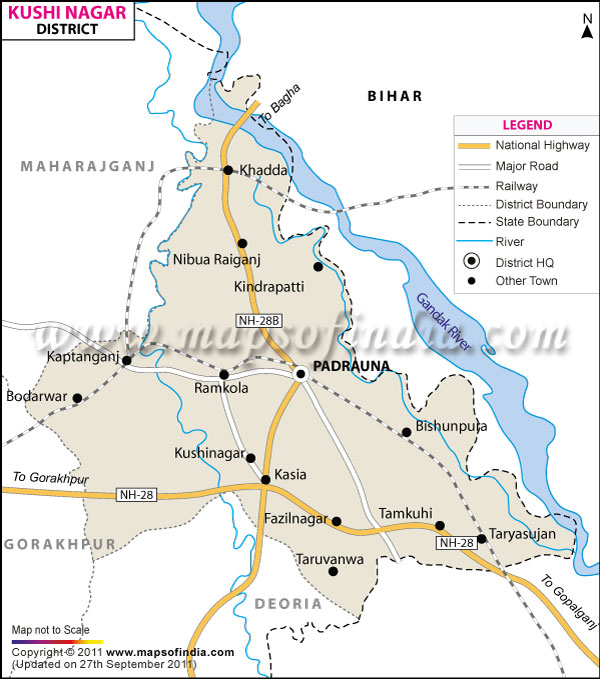
The area borders similarly on Bihar and is a part of the Purvanchal area of eastern Uttar Pradesh. The greater number of the residents are occupied with farming and other related jobs that constitute the foundation of the local economy. Valuative look at the Kushinagar district map will facilitate the apprehendance of location of the same in the eastern Gangetic plains, with other districts Gorakhpur, Maharajganj and Deoria adjacent to it.
It also boasts of the Buddhist monuments, monasteries and temples constructed by various Buddhist countries such as Thailand, Japan, and Sri Lanka. These buildings are monuments that mark the divine past of the last days of Buddha. The Kushinagar area map usually indicates where the Mahaparinirvana Temple is located that has a reclining statue of Buddha and which receives thousands of visitors annually.
The district had been able to evolve slowly into a cultural and religious tourism centre. The sacred sites are visited by pilgrims of the rest of the world as they pay their homage, and acquire knowledge of Buddhist teachings. The Kushinagar district map also acts as an informational resource to tourists who wish to cover monasteries, archaeological sites and historical monuments that are scattered all over the area.
Although it is a pilgrimage centre internationally, the district is still very attached to the traditions and the community life. The social life of the region is still influenced by local markets, festivals and agricultural activities. Knowledge of Kushinagar district map also gives the insight on the connectivity of the district by the road connection to the surrounding cities like Gorakhpur and Deoria.
History
Kushinagar has a historical value going way back in time. It belonged to the sixteen Mahajanapads that were existing at the period of Buddha. It acquired great historical significance since it was in the city that Gautama Buddha received Mahaparinirvana at around the 5 th century BCE. This incident made Kushinara a significant pilgrimage site to the Buddhists in Asia.
The historicity of the region to Buddhism was established when archaeological excavations revealed some ancient stupas, monasteries and inscriptions in the nineteenth and twentieth centuries. The Kushinagar district map that is utilized by historians usually indicates these excavation sites that show the strong Buddhist culture that once existed in this area.
Under the Mauryan regime and most especially under the reign of Emperor Ashoka, Buddhism was officially patronized by the royalty and a number of monuments were built in the area. It is said that Ashoka constructed pillars and stupas as a memory of the locations that were related to the life of Buddha. The developments made Kushinagar a strong religious centre.
After the fall of Buddhism in northern India, the region slowly faded away. Numerous monasteries were destroyed as ruins, and the religious places were comparatively not taken care of centuries later. Nevertheless, the presence of these locations was recorded by travellers and academics in other countries like China when they visited India. Their records subsequently assisted the historians in locating the ancient City of Kushinara.
The global interest towards the region still was revived with the rediscovery of the Buddhist ruins in the nineteenth century. Archaeologists like Alexander Cunningham made a significant contribution in the discovery of the ancient remains and the reawakening of history of the territory. The Kushinagar area map employed in the archaeological surveys was useful in identifying several ancient mounds and stupas, which proved the historical record found in the Buddhist texts.
The district was latter on made an administrative unit in Uttar Pradesh in modern times. Both its agricultural economy as well as its religious tourism industry has shaped its development. The Kushinagar district map remains a valuable source of information in learning the distribution of historical sites in the district as well as their connection to the settlements around them.
Culture
Kushinagar district has a culture that represents a mixture of conservative community lifestyle and the Buddhist heritage. The cultural practices and traditions of the eastern Uttar Pradesh have a strong culture grounded on the customs and traditions of the people of the district. Festivals, fairs and community meet-ups are very essential in preservation of social harmony and cultural identity.
The fact that there are international monasteries has also given the district a special multicultural aspect. Kushinagar is frequented by monks and pilgrims of other countries such as Thailand, Japan and Sri Lanka who come with different cultures. These monasteries are commonly drawn to the Kushinagar district map as they portray different building designs of Buddhist countries.
The district is also characterized by traditional folk music and dance.The Bhojpuri folk songs are an integral part of the local celebrations and include tales about the rural life, love and customs. The music instruments that normally accompany these performances include dholak and harmonium. Villages and towns around the district have fairs and local markets referred to as "melas'. These meet areas are the points of trade, entertainment and socialising. Most of these cultural facilities are available in Kushinagar district map, which allows the tourists to see the rich local spirit of the area.
Kushinagar cuisine is representative of the larger eastern subtlety related to the Uttar Pradesh cuisine. Local snacks and sweets are usually made during festivals and family parties. In general, the cultural identity of Kushinagar district is based on the interaction of the religious legacy, traditions and customs of the region. The district still maintains its cultural richness, and welcomes the visitors all over the world who visit the district to have a chance to experience its spiritual and historical value.
Language
The language has an important role on defining the culture of the Kushinagar district. Large majority of the people in the district speak Bhojpuri that serves as the most spoken language in the district. The Hindi language is also a common language that is used in administration, education and official communication. The census records show that about 77 percent of the citizens speak Bhojpuri as their native tongue and an estimated 21 percent of citizens speak Hindi as their native tongue.
The language environment of the district demonstrates the rural nature of the area. Sometimes in villages there is a tradition of Bhojpuri dialects, whereas in cities there is a tendency to use more and more Hindi in school and in offices and other institutions of the population. In some cases, the Kushinagar district map identifies those towns where administrative organizations promote the use of standard Hindi in addition to the local dialects.
Geography
The Kushinagar district is found in the east of Uttar Pradesh on the fertile Gangetic plains. It is a level alluvial terrain typifying the landscape, which is very favourable to agriculture. The district is close to the neighbouring state of Bihar and is a part of the wider Purvanchal plateau of western India.
The district is estimated to be 2873.5 square kilometres and has a number of administrative component parts such as tehsils, development blocks. These subdivisions and the system of villages, which covered the countryside, are demonstrated in the Kushinagar district map.
The region is also agricultural and has rivers and seasonal streams that lead to its productivity. These rivers have rich soils that aid in the farms of sugarcane, rice, wheat and maize. Therefore, farming is the key element of the economy and livelihood of the people of the district.
This climatic environment of Kushinagar district is that of the Indian north plains. Summers are usually hot whereas winters are not very cool but are relatively pleasant. Most of the rainfall of the year occurs during the monsoon season and without it, the agricultural activities will not take place. Kushinagar district map can assist the researchers and planners with the view of the way the natural features and settlements are spread on the territory.
The other geographical feature of the district is the predominantly rural pattern of settlement. The population is also predominantly distributed in the villages but not in the urban centres. Such distribution is easily identified by a detailed Kushinagar district map which shows that there are many rural habitation in this area.
The geographical location of the district is also close to key cultural and historical places thus leading to the growth of tourist destination in this area. The pilgrims and other visitors move through the roads linking Kushinagar and Gorakhpur as well as other cities around it. The geography of Kushinagar district, in general, is a manifestation of the features of fertile Indo-Gangetic plains, where agriculture, rural settlements and historical sites are located in the landscape formed by rivers and centuries of human occupation.
| Facts of Kushinagar District | |
|---|---|
| State | Uttar Pradesh |
| District | Kushinagar |
| District HQ | Lakhimpur |
| Population (2011) | 3564544 |
| Growth | 23.20% |
| Sex Ratio | 961 |
| Literacy | 65.25 |
| Area (km�) | 2873.5 |
| Density (/km�) | 523 |
| Tehsils | Hata, Kasya, Padrauna, Tamkuhi Raj |
| Lok Sabha Constituencies | Kushinagar |
| Assembly Constituencies | 7-Fazilnagar, Hata, Khadda, Kushinagar, Padrauna, Ramkola, Tamkuhi Raj |
| Languages | Hindi, Bhojpuri |
| Religion | Predominantly Hinduism |
| Rivers | --- |
| Lat-Long | 26.739862,83.887298 |
| Travel Destinations | The Parinirvana Temple, The Mahaparinirvana Temple, The Ramabhar Stupa, The Nirvana Stupa, Linh Son Temple, Thai Temple, Ramkola Satiansuiya Temple, Govt. Buddha Museum etc. |
| Government Colleges/Universities | Buddha Post Graduate College, Ram Dhani Singh Nahara Devi Govt. Degree College, Mahanth Shyam Das Mahavidyalya, Babu Tahsildar Shahi Mahavidyalaya, Indu Devi Rampati Mahila Degree College, Sri Tarachand Degree College, Shri Bhagwan Pg College etc. |
FAQs
Q1: Why is Kushinagar district historically important?
It is believed to be the place where Gautama Buddha attained Mahaparinirvana.
Q2: What is the main language spoken in Kushinagar district?
Bhojpuri is the most widely spoken language, followed by Hindi.
Q3: Why do international tourists visit Kushinagar?
They visit mainly to see the Buddhist pilgrimage sites associated with Buddha’s final days.
Q4: What is the main occupation of people in Kushinagar district?
Agriculture is the primary occupation for most residents.
Last Updated on : May 08, 2026
