




Introduction
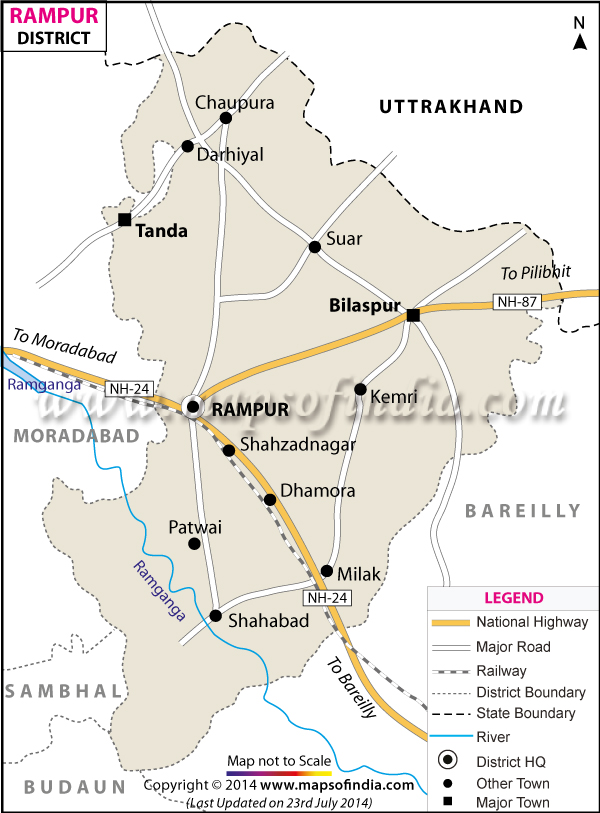
Rampur district map shows that Rampur is an administrative district in Uttar Pradesh state in India in the north part of the country. It is a division of the Moradabad division and its head office is at the city of Rampur. The district is situated in a very favorable geographical location in between Himalayan feet Hills to the north and central plains of Uttar Pradesh to the south. This unique regional character of the country forming as a result of agricultural activities, the legacy of princes and cultural plurality is the combination of its landscape, history and demography.
It is historically known as a seat of the former princely State of Rampur which was under the rule of Nawabs of Rampur. The residue of this history has created a permanent architectural and cultural impression on the region that would be reflected in its palaces, mosques, libraries and music and literature traditions. Meanwhile, Rampur is now a contemporary administrative district which is administered within the democratic model of the Republic of India, which has a features of rural villages and developing urban areas.
History
Rampur district map can be used to understand history closely related with the political history of the north of India in the times of Mughals through post-Mughal. Before the formation of the princely state, the region was a part of the lands which were affected by the Mughal Emperor. During the eighteenth century, with the disaffirmation of Mughal central power, Rohilla Afghan chiefs developed dominion over areas of Rohilkhand in which Rampur is located, the larger area to which the region of Rohilkhand pertains.
Frontier Rampur was established under the Rohilla ruler Nawab Faizullah Khan who established the princely State of Rampur in 1774 following the Rohilla War. The British East India Company which had been meddling in the local wars had identified Rampur as a British protectorate state. The state was under internal autonomy of the Nawabs of Rampur who also recognized British suzerainty. With time they built Rampur town into an administrative, cultural and learning centre.
In the nineteenth and early twentieth centuries, Rampur State remained an entity of British paramountcy as a princely state. It was relatively stable in comparison with most other regions and its rulers brought some administrative and infrastructural changes. In 1947, the death of the Indian Union was achieved by annexation of the princely state by India, which was newly independent. It was later incorporated in the state of Uttar Pradesh in 1949 and was restructured as Rampur district of Indian administration system. Similar to how a Rampur district map helps trace administrative evolution, the Rampur district map can also be used to understand historical territorial changes.
The district has developed since independence under the democratic system of India. The modern form of political expression has been influenced by political representation via elected bodies, development programmes and integration into state-level planning. Although the era of the princely has long passed, the historical legacy of the same does affect the identity and heritage landscape in Rampur. Researchers who consult a Rampur district map for historical comparison may also analyse the Rampur district map to study princely state boundaries.
Culture
Cultural life can be shown by Rampur district map as the result of centuries of contact of other communities and traditions. Hindus, Muslims and the smaller religious groups have coexisted together which has created a common cultural domain where festivals, customs and social practices are mostly characterized by a trace of cross influence. Eid al-Fitr and Eid al-Adha are celebrated by most of Islamic communities and Diwali and holi are celebrated by Hindus equally with great enthusiasm in most parts of the district.
Rampur has a respectable position in the historical culture of music and literature. Classical music and poetry, particularly in the Urdu school of thought, were patronized by the court of the Nawabs. This patronage helped in creation and maintenance of unique musical styles and literary forms. Even in the modern times, the cultural milieu of the district includes the gatherings with recitation of poetry and traditional music especially in the urban centres. Textile industry, embroidery and small-scale crafts also provide the cultural and economic life of the district.
The food in Rampur is a representation of its mixed tradition. Mughal and North-Indian cuisines have been influential in the preparations of food made during special events and festivals. The gastronomic environment includes meat based preparations, aromatic rice dishes, and assorted sweets in addition to vegetarian food common to western Uttar Pradesh. Rural and urban local weekly markets and seasonal fairs still remain centres of social interaction.
The architectural heritage also adds to the culture of the district. The structure of old mosques, imambaras, and palaces remind of the time of the Nawabi, and temples and other religious edifices are reminders of the multiplicity of religions practised here. Such constructions not only are used in religious activities but also they are historical monuments that connect the current generations with the history they have in common. Visitors may consult the Rampur district map to plan visits to heritage structures and important religious sites.
Language
Rampur district map can demonstrate a reflection of its historical and demographic make up in the language. The census of India 2011 has shown that Hindi is the most spoken language in the district. It also serves as the main administration, education and daily communication medium. Government offices, schools and official documentation are written in the Devanagari script of Standard Hindi.
The second most notable language is Urdu, which has a significant amount of cultural importance. Due to the history of the district as a princely state with the governance of Muslim rulers, Urdu evolved to be a medium of courtly culture, literature and good taste. It is still widely spoken especially among the Muslim people and is used in cultural occasions, religious talks and literary conferences. Urdu is a language in Perso-Arabic script and is popularly known to be one of the official languages of Uttar Pradesh.
The percentage of the population speaking Punjabi is lower, only in the communities where the families immigrated during or after Partition of India in 1947. There are also local dialects of Hindi in rural areas which were affected by other neighbouring areas of Rohilkhand.
The language variability promotes interpersonal communication between societies and strengthens the compound cultural environment of the district. Educational establishments usually focus on Hindi and English language as teaching and learning languages, but there are Urdu medium schools spread across some regions, which guarantee the further preservation of linguistic traditions. The Rampur district map may also assist in identifying rural and urban linguistic concentrations.
Geography
Rampur district map helps understand that the district is located in the north-western part of Uttar Pradesh and it belongs to Rohilkhand. Geographically, it would be found on the massive flat Indo-Gangetic plain which is a plain terrain and fertile alluvial soil. The size of the district is 2,367 square kilometres, not very large as compared with other state districts.
The state of the Uttarakhand, Udham Singh Nagar district is on the north facing of the district. Purely eastward, there is the Bareilly district and purely westward, there is the Moradabad district and purely south, the Badaun district. This is where Rampur is placed in a maze of major regional roads that can enable the city to trade and communicate with other states and districts.
The district is crossed by a number of rivers, seasonal streams and also adds to the fertility of the soil and agricultural productivity. Koshi River passes through Rampur town and it is used in irrigation. These watercourses have deposited alluvial soils that have been deposited over the centuries to form fertile agricultural land that can support various patterns of cropping. Canals and tube wells support irrigation supply of water in drier months.
Rainy season normally tends to be around towards end of June up to September and this is when majority of the annual rainfall is received which is very vital especially in the field of agriculture. Winters are rather chilly and comfort between -10 degrees Celsius on coldest nights in the period of November-February.
The district has mostly agricultural land use. There are extensive areas of land that are used in the production of wheat in the rabi season and paddy in the kharif season. The other important crop is sugarcane, which can be attributed to the larger agricultural trend of western Uttar Pradesh. Pulses and oilseeds or vegetables are also produced, which are used on the local level and regional markets.
The major centre of urbanisation in the Rampur district is around the city of Rampur which is the administrative and business centre of the area. In lots of villages with smaller towns, a countryside is characterised by a settlement pattern typical of the Indo-Gangetic plains. The road and rail connectivity of the district to the key cities of Uttar Pradesh and the neighbouring states makes the district more economically integrated.
One of them is seasonal floods in lowlands during heavy monsoon rainfalls and pressures related to population increase and intensive agricultural practices. Still, the economy of the district is still based on natural resources and fertile soil which support the existence of the big part of rural population.
On the whole, the Rampur district geography is the basis of its agricultural flourishing, residential layout and historical consequences. Its plains and rivers and climate have formed human settlement throughout the centuries contributing not only to the emergence of a princely state but also the interaction of a modern administrative district in Uttar Pradesh. Overall spatial planning and settlement patterns are effectively illustrated in the Rampur district map.
| Facts of Rampur District | |
|---|---|
| State | Uttar Pradesh |
| District | Rampur |
| District HQ | Rampur |
| Population (2011) | 2335819 |
| Growth | 21.42% |
| Sex Ratio | 909 |
| Literacy | 53.34 |
| Area (km2) | 2367 |
| Density (/km2) | 987 |
| Tehsils | Bilaspur, Milak, Rampur, Shahabad, Suar, Tanda |
| Lok Sabha Constituencies | Rampur |
| Assembly Constituencies | Bilaspur, Chamraua, Milak, Rampur, Suar |
| Languages | Hindi, Urdu |
| Rivers | --- |
| Lat-Long | 28.87835,79.122734 |
| Travel Destinations | Jama Masjid, Raza Library, Rampur Planetarium, Gandhi Samadhi, Kothi Khas Bagh, Ambedkar Park etc. |
| Government Colleges/Universities | Govt. Raza Degree College, Government Polytechnic, Govt Girls Pg College etc. |
FAQs
Q1: What is the administrative headquarters of Rampur district?
The administrative headquarters of Rampur district is the city of Rampur in Uttar Pradesh.
Q2: When was Rampur integrated into independent India?
Rampur acceded to the Indian Union in 1947 and was merged into Uttar Pradesh in 1949.
Q3: Which historical institution is most associated with Rampur’s scholarly heritage?
The Rampur Raza Library is the institution most closely associated with the district’s scholarly heritage.
Q4: What is the primary economic activity in Rampur district?
Agriculture is the primary economic activity in Rampur district.
Last Updated on : July 13, 2026
