




Introduction
It is the popular district of the state of Uttar Pradesh that is located in a prime region known as Gautam Buddha Nagar which is found in the National Capital Region (NCR). It was established in 1997 and it derives its name after Gautama Buddha. It possesses rapidly expanding urban centres such as the Noida and Greater Noida which are typified by strategically designed infrastructures and IT parks, education centres, and industrial parks. Gautam Buddha Nagar with its good connectivity to Delhi by expressways and metro has become a significant real estate, business and educational hub. It is a blend between the rural and the urban.
History
The Gautam Buddha Nagar history dates back to the early days of the ancient civilization of fertile Doab region in-between rivers Yamuna and Ganga. Due to the alluvial soil and strategic location, the region has been inhabited since early historic times. The archaeological evidence of exquisite regions shows the presence of the human population since ancient times, which was based on agriculture and trade. The district was a part of the great cultural space of the region of northern India, where great empires and religions grew and collapsed.
The region was affected by great dynasties in ancient times including the Mauryas and the Guptas. Buddhism became common throughout northern India and, in particular, under the reign of Emperor Ashoka, during the Mauryan period. Even though the district contains no substantial Buddhist monuments, the very name of the district is evidence of the spiritual heritage of Gautama Buddha and the dominant Buddhist influence in the Gangetic plains. Probably, the territory gained advantage of trade routes between significant cities in ancient India.
In the medieval times, the region became significant as it was close to the political centre Delhi which was the political centre of the Delhi Sultanate and the Mughal Empire. The region was mainly an agrarian one under the Mughal rule with villages as the administrative unit through a systematic revenue system. There was production of wheat, sugarcane and pulses among others. The land revenue policies of the Mughal incorporated the region into a larger imperial economy and retained the rural nature of the region.
The region was also politically unstable after the fall of the Mughal rule in the eighteenth century. Power went between the regional powers like Rohillas and the Marathas and ultimately became British dominated in the early twentieth century. The region was incorporated in the United Provinces of Agra and Oudh when the region came under British control. The canal irrigation systems, enhanced road connectivity, and restructured land revenue were brought by the colonial government. These reforms had long-term effects on agrarian relations and rural society. The district was also involved in the freedom struggle in India where even the inhabitants contributed to nationalist movements including Non-Cooperation Movement and Quit India Movement.
It took several decades after the region was granted independence in 1947 to be mainly rural. A significant change started in 1976 when Noida was developed as a planned industrial township to relieve population pressure on Delhi. This was accompanied by the formation of Greater Noida in the 1990s to ensure the further growth of industry and residential. Gautam Buddha Nagar was divided into a separate district in 1997.
Culture
The Gautam Buddha Nagar culture is a non-conformist mixture of traditional rural setting and rapid urbanization. It is located in the West of the Uttar Pradesh state and is the area of the National Capital Region that has experienced a significant demographic and cultural shift during the past few decades. Although some of the metropolitan cities such as Noida and Greater Noida are the reflection of the cosmopolitan lifestyles, the ancient customs and tendencies of the society are observed in the neighboring villages.
Conventionally, local culture was agrarian. Traditional folk songs, seasonal celebrations, and community meetings have historically shaped social identity. These celebrations are Diwali, Holi, Eid and Navratri that are celebrated with a lot of enthusiasm as a sign of the religious diversity and the harmonious relations between the communities in the district. Village fairs (melas) and religious gatherings in the temples are much more important in rural regions and they are strengthening social integration besides preserving local culture.
Another element of culture is language. The dominant language used is Hindi and Urdu is also widely spoken especially among the Muslim population. Migration from other regions of India seeking jobs and education sources have seen the English language and other regional languages become common in the cities. This multilingualism implies the changing social nature of the district.
Gautam Buddha Nagar cuisine is an amalgamation of old Indian cuisine and contemporary food culture. Staple foods in rural households are wheat based breads like Roti and Paratha, lentils, vegetables and dairy products. The food here is also diverse; as cities have both street food and international cuisines due to globalization and urbanization.
Modern culture has been influenced to a great extent by education and the media. Availability of the known institutions like Amity University and Shiv Nadar University has resulted in students within and outside of India who have created a youthful and progressive environment. Noida and Greater Noida have shopping malls, multiplexes, art exhibitions and cultural festivals which add to the urban lifestyle.
Meanwhile, the traditional values like respect to the elders, joint families, and solidarity of communities are still prominent particularly in the rural regions. The mix of old and new, i.e. agricultural traditions and IT parks and high-rise apartments also characterizes the cultural identity of Gautam Buddha Nagar.
Language
The example of the old and new urbanization is Gautam Buddha Nagar. The district is also found in the western region of Uttar Pradesh, National Capital Region (NCR) that has accommodated regional dialects and cosmopolitan language because of the arrival of migrants seeking education and the pursuit of economic growth.
Hindi and English is the common language of management as well as education and life in general in the district and is thus the most commonly spoken language in the area. In rural areas the language spoken by the locals is a dialect of western Hindi; Khari Boli that is also the basis of standard Hindi. The countryside folks and social traditions have a tendency to carry the farming culture and social practices into talk patterns in villages where there are rural idioms, proverbs and phrases.
The Urdu language is also a significant part of the linguistic culture in the district, especially amongst Muslims. It is applied in cultural, religious, and literary uses and helps the region to have a composite heritage. The interrelationship between Hindi and Urdu enables the larger Ganga-Jamuni tehzeeb (syncretic culture) of the north of India.
Having an urban area being planned as in Noida and Greater Noida, the linguistic profile has become very diverse. The use of English has been very much popular particularly in the business world, in institutions of higher learning, in information and technology, and in the corporate world too. The English language is used in many schools and universities in the district which makes it more prominent.
Geography
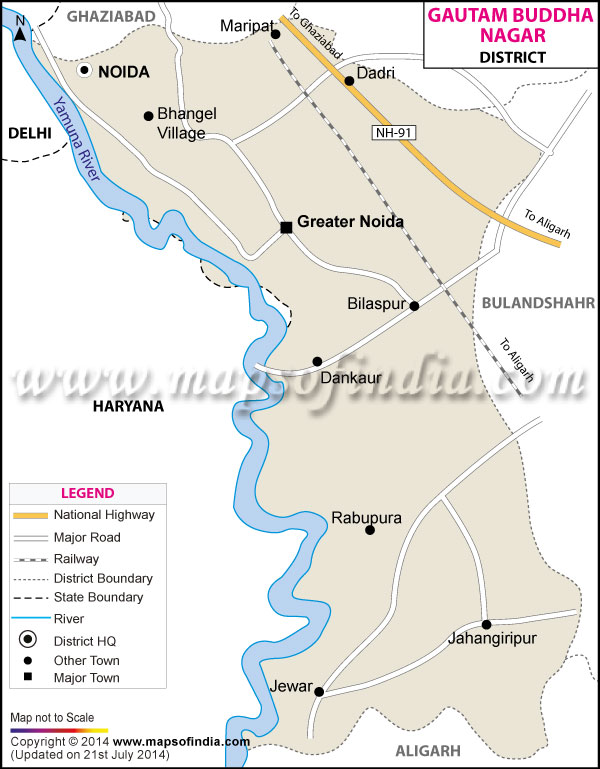
Gautam Buddha Nagar is a suburb in the western Uttar Pradesh and in the National Capital Region (NCR). The district is bounded by Ghaziabad and Delhi to the north, Bulandshahr to the east, Aligarh to the south, and the Yamuna River (bordering Haryana and Delhi) to the west.
On the physiographical side, the district is situated on the fertile Indo-Gangetic Plain, that is, the Doab area between the rivers Ganga and Yamuna. Its western boundary is a natural boundary of Yamuna River that has a considerable impact on the topography and agriculture within the district. The ground is usually plain, fairly mellow with alluvial deposits of soil that have been laid down in ages through river systems. This is very fertile soil which supports crops like wheat, sugarcane, rice and vegetables which were initially grown by people before mass urbanization.
The Gautam Buddha Nagar climate falls under hot semi-arid climate. The weather during summers is hot and dry and the temperatures are usually above 40°C in the months of May and June. A medium rainfall of around three months during the months of July to September is referred to as the monsoon season but in most cases there is waterlogging in the lowlands due to the rainfall. Winters are cool and occasionally humid and they range to single digits in the winter season, December until February.
The physical landscape in the district has dramatically changed due to urban development. Planned areas like Noida and Greater Noida also have arranged areas, broad roads, residential estates, industries and green belts. Large expressways such as Yamuna Expressway are improving connectivity and also bring about regional integration.
In spite of the high advancement of urban life, some areas of the district are still of rural character containing farmlands, ponds, and village communities. Development has come with environmental issues like air pollution, depletion of the ground water and destruction of the green cover.
| Facts of Gautam Buddha Nagar District | |
|---|---|
| State | Uttar Pradesh |
| District | Gautam Buddha Nagar |
| District HQ | Noida |
| Population (2011) | 1648115 |
| Growth | 37.11% |
| Sex Ratio | 851 |
| Literacy | 80.12 |
| Area (km2) | 1269 |
| Density (/km2) | 1252 |
| Tehsils | Dadri, Sadar (Noida), Jewar |
| Lok Sabha Constituencies | Gautam Buddha Nagar |
| Assembly Constituencies | Gautam Buddh Nagar, Dadri, Jewar |
| Languages | Hindi, Urdu |
| Rivers | Yamuna |
| Lat-Long | 28.359985,77.551017 |
| Travel Destinations | The Great India Place,Okhla Bird Sanctuary, Iskcon Noida, Worlds Of Wonder, Worlds Of Wonder Water Park, Adventure Hangout etc. |
| Government Colleges/Universities | Dr. A.P.J. Abdul Kalam Technical University (AKTU), Government Pg College, Army Institute of Management and Technology (AIMT), Greater Noida, Hindustan Institute Of Dental Science, Mahamaya Technical University, Vv Giri National Labour Institute etc. |
FAQs
Q1: How has Gautam Buddha Nagar transformed over the years?
The district has shifted from a very rural based economy to that of a large urban and industrial center. Also there was heavy planning which played a key role in this growth.
Q2: Which industries do we see in Gautam Buddh Nagar?
In the district we see that information technology, electronics, manufacturing, real estate and automobile related industries are large scale players.
Q3: What is the reason that Gautam Buddh Nagar is a major business destination?
The district is a home to many IT companies, industrial parks, corporate offices and startups. Also its excellent connection to Delhi has made it a preferred destination for businesses from all over the country.
Q4: Which river marks the western border of Gautam Buddh Nagar?
The Yamuna River which forms the western border of the district. Also over the past years it has supported farming and today plays a role in the region’s geography.
Q5: Does Gautam Buddha Nagar have rural and urban areas?
Yes, in many of the district’s areas we see very fast growth of cities which at the same time have traditional villages. This has created a distinct social and economic character.
Q6: How does Gautam Buddh Nagar manage development and tradition?
Modern growth of infrastructure is seen in many areas but at the same time in many villages life is still centered around traditional farming practices, festivals and local customs. This is what gives the district its unique character.
Q7: What is the headquarters of Gautam Buddha Nagar district?
The district headquarters of Gautam Buddha Nagar is Noida, one of India's leading IT and industrial cities.
Last Updated on : July 27, 2026
