




Introduction
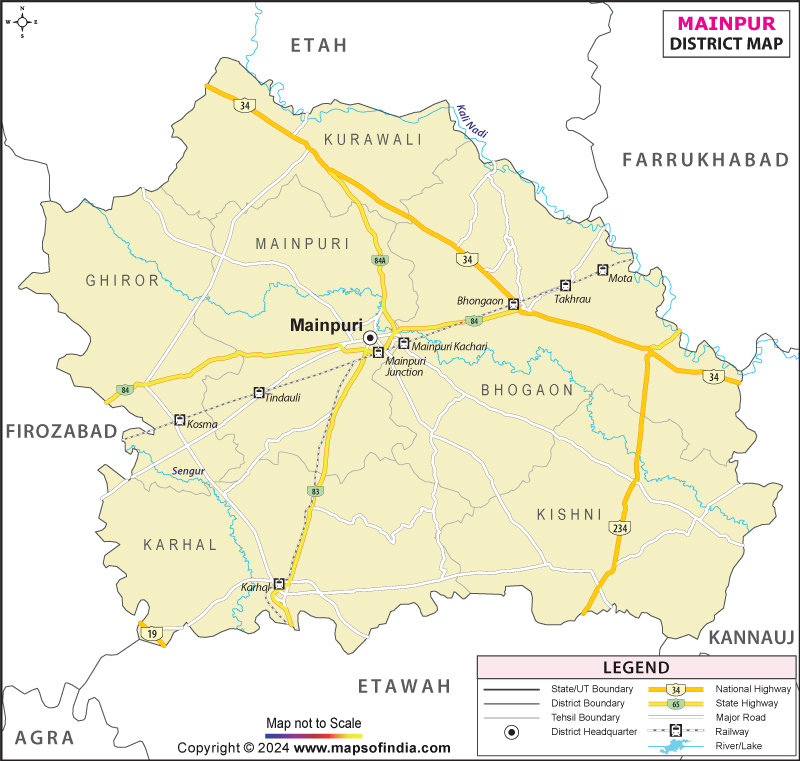
Mainpuri is a major district in the state of Uttar Pradesh in northern India. It belongs to Agra Division and it is located on a location of the fertile plains of Ganga-Yamuna Doab region. The administrative headquarters is situated in the city of Mainpuri functioning as the political, economic and cultural centre zone of the region. The map of the Mainpuri district generally shows the broad profile of its borders, its neighbouring districts and major roads, which allow its readers to see its position in the state of Uttar Pradesh and its connection with its neighbours.
Little topography and fertile alluvial deposits deposited by centuries of river systems of the Indo-Gangetic plain typify the landscape of the district. The local economy is still agricultural in nature and therefore the settlement, trade and seasonal movement patterns. There are towns and villages spread over the plains, in a kind of agrarian arrangement characteristic of the northern Indian agrarian districts, and the habitations are compact, and are enclosed by cultivated areas of land. The Mainpuri district map generally shows the headquarters of the district and major transport networks to provide a rough geographical guide in which the reader can see how the settlements are organized within the administrative boundaries of a district.
Despite being predominantly rural, the district has been undergoing slow change over the years since independence due to increased education, better road access and availability of social welfare programs. These changes have promoted low urbanization in the town of Mainpuri as the lifelong culture of the villages remains agricultural. Consistency between the past agrarian heritage and modern administrative systems is still observable in the district. A Mainpuri district map helps readers identify neighbouring districts surrounding the region.
History
The history of the Mainpuri district is connected to the general historic processes that influenced the northern India. The fertile lands of the Ganga valley were able to sustain initial agricultural communities and evidence of the same is shown in the nearby areas which indicates that organised settlements were used in the ancient times. The local chieftains and Rajput clans built castellated towns and regulated the farmland around them, which in several centuries was the foundation of the initial political organisation in the region.
In the medieval period, the region was included in kingdoms that had the Delhi Sultanate and later the Mughal Empire. The Mughal rule also introduced systematic land assessment, better record keeping and involvement in wider trade systems. The increased agricultural activity of this time reinforced the stable economy, the country village communities and patterns of land ownership became more established in the rural society. The demarcations, which are apparent in a Mainpuri district map today, did not form so clearly until a later date, but the administrative tradition of previous empires had an influence on the structured revenue system within the district.
As the Mughal authority declined in the eighteenth century, it resulted in realignment of the regions in north India. Before the British took over the region, it had influence by various powers that were in the region. By the nineteenth century the annexation of the territory into the North-Western Provinces of the British rule was a fact. Surveyors of land, revenue settlements and territorial demarcations were carried out by colonial administrators making definite boundaries of districts, which created administrative continuity in future. These geometrical dividends gave the basis to the contemporary sketch as is depicted in the Mainpuri district map.
After the independence of India in 1947, Mainpuri was incorporated in Uttar Pradesh in the Republic of India. Colonial rule was ousted by democratic governance and elected representatives started to influence the development priorities. The participation of the grassroots was enhanced by land reforms, rural education expansion and development of panchayati raj institutions. As the decades have changed, the living standards have changed, slowly, and electrification, irrigation and healthcare have contributed to the progress of the district, without disrupting the agricultural foundation of the district.
Culture
Mainpuri district is in the larger western and central Uttar Pradesh heritage and this is evident in the cultural traditions within the area. The people are mainly Hindu and there is a significant minority of Muslims, which creates a compound culture with coexistence and similar social traditions. Religious holidays are the part and parcel of the community. Diwali, Holi, Navratri and Dussehra are celebrated with spirit in both the towns and villages whereas Eid al-Fitr and Eid al-Adha are celebrated with piety and social harmony.
The Sheetla Devi Temple is also one of the religious landmarks that are frequented by devotees especially in annual fairs. These events bring in participants not only in neighbouring districts but also spur local trade which makes the linkage between faith and economic activity stronger. In rural areas, the fairs are still significant as a place of goods, livestock and farm products but also where people can entertain and be able to interact in terms of culture.
Folk music is still very popular in the villages; people sing when they marry and also in festivals of harvests and seasons. Oral storytelling and religious songs help to save the regional identity. Even though there is no well known school of classical art in the district, the everyday manifestations of culture are part of the bigger tapestry of the heritage of Uttar Pradesh.
Food carries the sign of a rich agricultural area and weather. The main grain used is wheat which is made into chapati and other breads and eaten every day. Rice is consumed on special occasions and festivals. Lentils, green vegetables and dairy products play a major role in the family meals whereas sweets made of milk and clarified butter are a household custom during celebrations. These eating habits are determined by the trends of farming and the proximity of products.
The district is structured around family structures and village communities in terms of social life. Conservative practices still affect the marriage rituals, seasonal observations and the collective decision making. Meanwhile, enlightenment and exposure to the media have shown some modernity which has had the effect of creating a smooth integration between the traditional values and the modern ones.
Language
The major language used in the whole of the Mainpuri district is the Hindi language which is the language of administration, education and communication. It is written in the Devanagari script, and is employed in government offices, in schools and courts. The census of 2011 carried out a census that showed that the huge majority of residents spoke Hindi as their mother tongue, which highlights that it is predominant in the daily life.
Urdu is a language spoken to groups of Muslim people and is still important in the religious, poetic and cultural terms. It is inscribed in the Perso-Arabic script and is frequently recited in the religious preaching and literary meetings. In learning institutions, English is spoken and it is also used in the upper administration functions, but it is not prevalent in the rural homes.
Informal speech patterns include local dialects that are impacted by the speech patterns of Braj and Kannauji. These dialects make communication rich and they are present in folk songs and story telling traditions. Lingual diversity hence exists in a context of reciprocal intelligibility and enhances social cohesion within societies.
Geography
The district of Mainpuri is found in the alluvial plains on the south-western part of the Uttar Pradesh and is between Yamuna and the Ganga rivers. The soil is mostly level and therefore supports high agricultural production and the rural population density is also around 678. Typically, the Mainpuri district map of the demarcates its border with other neighbouring districts such as Etawah, Farrukhabad, Kannauj, Firozabad and Etah and offers a bare notion about the surrounding atmosphere.
The size of the district is approximately 2765 square kilometres. The soil commonly is alluvial and very productive and they have supported the growth of wheat, rice, pulses and oilseeds. The use of tubes wells and canals facilitates irrigation plants to reduce their dependence to monsoon rain since this will ensure that there are more than one cropping seasons. Seasonal streams and minor rivers cover the district making the soils fertile. Some basic administrative and geographical orientation could be achieved with a Mainpuri district map. A Mainpuri district map is useful for basic administrative and geographical orientation.
The climate is the pattern of the typical north Indian monsoon of hot summer, a monsoon season in second half of June to September, and cool winters. The temperature during the month of May and June is usually above 40 degrees Celsius and the nights during the winter season in the months of December and January are extremely cold. Monsoon rainfall is important in ground water replenishment and support agricultural cycles.
The patterns of settlement are mostly rural with the villages located near the fields of cultivation. Mainpuri town serves as the main urban centre that offers administrative services, markets and learning institutions. The headquarters are linked to the local towns and villages by roads which help in trade and transport. The Mainpuri district map is thus a simple visual guide to administrative boundaries, transportation routes and the site of headquarters with no complex thematic information.
Green problems consist of groundwater loss, stress on agricultural land and sustainable agricultural production. However, agriculture remains the economic nature of the district as it is helped by fertile land and developed irrigation systems. The cultural diversity of the historical continuity and the geographical location impact the identification of the entire identity of the district, which can aid understanding with the help of the Mainpuri district map.
| Facts of Mainpuri District | |
|---|---|
| State | Uttar Pradesh |
| District | Mainpuri |
| District HQ | Mainpuri |
| Population (2011) | 1868529 |
| Growth | 17.02% |
| Sex Ratio | 881 |
| Literacy | 75.99 |
| Area (km2) | 2745 |
| Density (/km2) | 670 |
| Tehsils | Bhogaon, Karhal, Mainpuri |
| Lok Sabha Constituencies | Mainpuri |
| Assembly Constituencies | Bhongaon, Karhal, Kishani, Mainpuri |
| Languages | Hindi, Urdu |
| Religion | Predominantly Hinduism |
| Rivers | --- |
| Lat-Long | 27.220441,79.100761 |
| Travel Destinations | The Raja'S Palace, The Garhi, Foolbagh, Lohia Park etc. |
| Government Colleges/Universities | Government Polytechnic College, Shre, Chitra Gupta Post Graduate College etc. |
FAQs
Q1: Where is Mainpuri district located?
As the Mainpuri district map also shows, the district is situated in the south-western part of Uttar Pradesh in northern India.
Q2: What is the main occupation in Mainpuri district?
Agriculture is the primary occupation of most residents.
Q3: What does a Mainpuri district map usually display?
It generally shows administrative boundaries, neighbouring districts and major roads.
Q4: What is the administrative headquarters of Mainpuri district?
The administrative headquarters is the city of Mainpuri.
Last Updated on : May 08, 2026
